

 Română
 English
 Deutsch
 Magyar
Beyond each month’s numbers, many companies run short objectives: a brand being promoted, a focus product, a campaign, a category to push. Each has its own target per unit and ends with the month. With Objectives you set them up in minutes, and the results add up automatically into a number the scorecard reads.
One rule, many objectives
- The rule says once how every objective of a kind is scored: what is recorded (pieces sold, for example), what each person’s target is, how far they got and what they earn. Its formulas are also explained in plain words.
- Settings per objective, such as the points for reaching the target, with a default value each objective can change.
- When someone has several objectives in the same month, the results are added up, averaged, or the lowest or highest is taken — as the company chooses.
The month’s objectives, in minutes
- A name, the month and a target for each unit; units without a target do not have the objective.
- A manager sets objectives for their own units and changes only their own.
Achievements, in a grid or from a file
- A grid with the people (or units) and the values to fill in; an empty field means “not recorded”, not 0.
- Or an Excel or CSV file: a person by employee number or email, a unit by code or name. The whole file is checked first; if one row is wrong, nothing is saved and you see what to correct.
- Each manager sees and fills in only the people they manage, and never their own achievements.
Tied to the score
- When the month closes, each objective is scored automatically and the results go into the rule’s metric, which you add to a scorecard like any other.
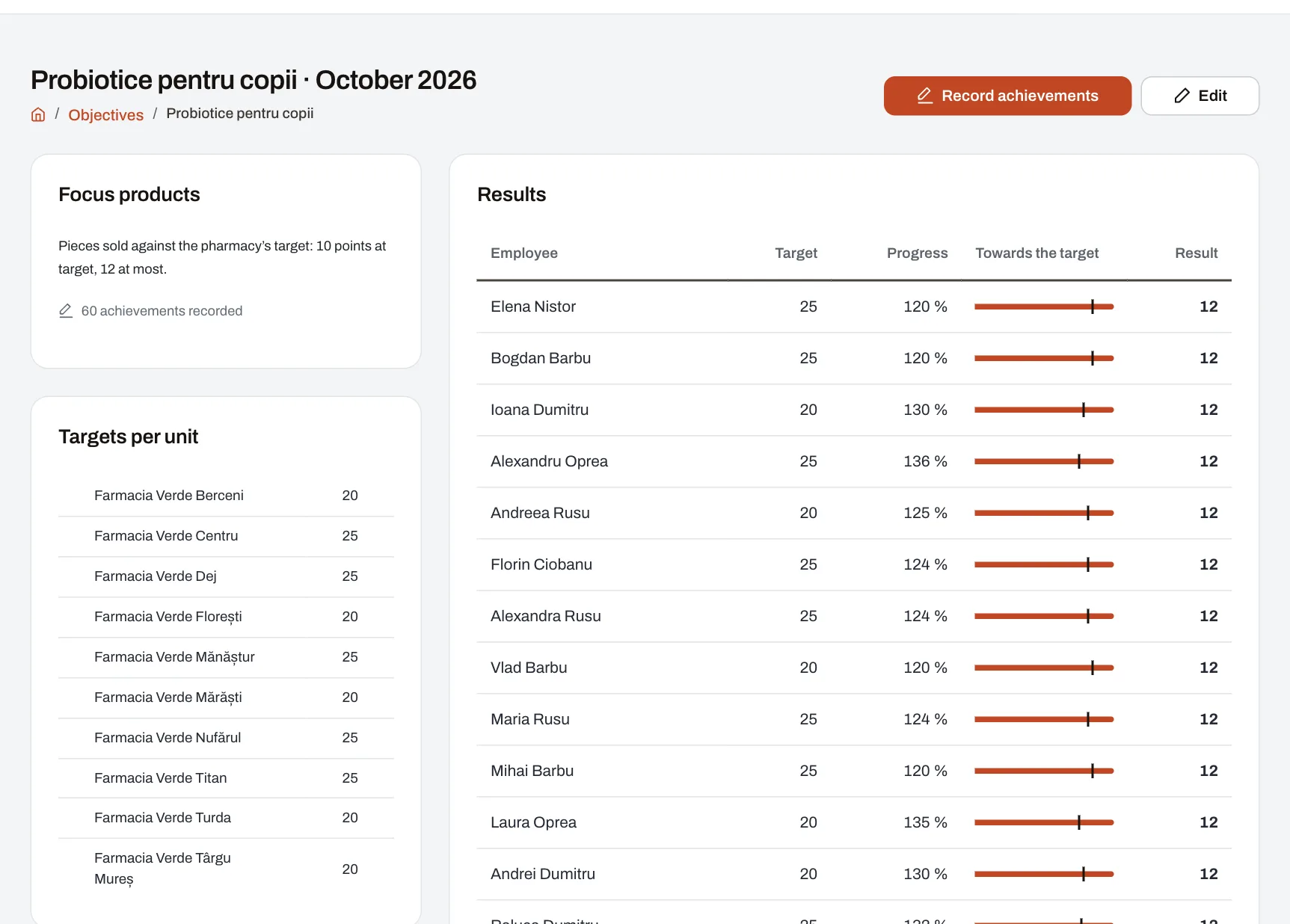
- An objective’s page shows each unit’s target and, for each person, the target, how far they got and the points earned.
Part of the Performance module; scoring rules are built on Professional and Enterprise.