 Română
 English
 Deutsch
 Magyar
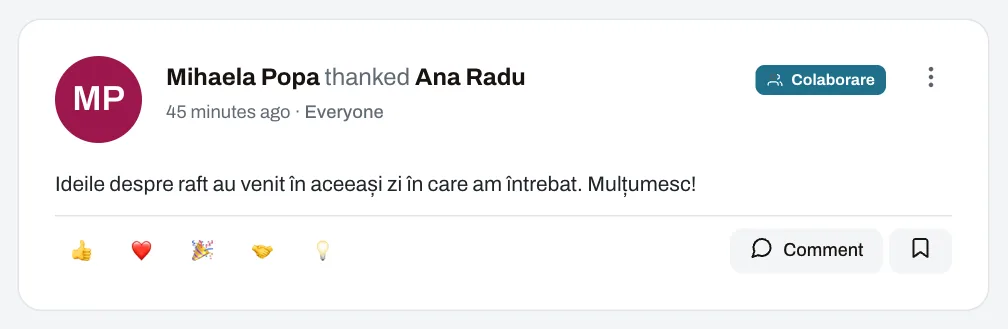
A “thank you” said at the counter is forgotten by evening. Said where the whole company sees it, tied to a value you stand for, it stays. Kudos and celebrations make recognition a habit: anyone thanks colleagues in public, and the days that matter — a birthday, a work anniversary, a new colleague’s first day — are celebrated automatically, without HR keeping a list. They are for every employee with an account.
How it works
- The company sets its values. Moderators (HR, by default) add the company’s values, for example “Care for the customer” or “Teamwork”, each with its colour and icon.
- A colleague sends kudos to one or more colleagues, with a few words and, if they like, a value. The result: the kudos appears in the company feed and the people thanked get a notification.
- Kudos add up on the profile. Everyone’s profile shows how many kudos they have received for each value.
- Celebrations are posted automatically every morning. Pulsika writes a company post with the day’s birthdays, work anniversaries (from one year up, by hire date) and new colleagues starting today. Each person is celebrated once a day, and former employees never.
- The company chooses the audience. Celebrations go to the whole company or only to each person’s unit; each kind of celebration can be turned off.
Example: a chain of electronics shops
A chain has 30 shops. Its values are “Customers leave knowing more”, “We help each other between shops” and “Reliability”. A sales adviser in Brașov lent stock to a shop in Sibiu on a busy Saturday; the Sibiu manager sends him kudos for “We help each other between shops”, which colleagues across the chain see. The same morning, the company post wishes happy birthday to three colleagues who chose to show theirs and welcomes two new colleagues.
Colleagues’ profiles
- Everyone writes a few words about themselves and their interests and adds a photo and a cover; only the person changes their profile.
- A birthday appears only if the person chooses to show it, and then without their age. People can turn off their own work anniversary.
- Colleagues can follow each other, and the feed can be filtered to the people followed.
- The people directory lists everyone with an active account and shows only what each person chose to show, not data from their HR record.
Who sees what
- Kudos are public within the company: recognition is seen.
- Celebrations are seen by the audience chosen: the whole company or the person’s unit.
- Moderators can take down a profile photo, cover or text that breaks the rules.
In KPI too
Kudos received can become a metric — “Kudos received”, counted where each person thanked works — for teams and the company, never for a single person. A unit where people help each other shows up, without recognition turning into an individual grade.
Limits
- Nobody can thank themselves, and kudos go only to colleagues with an active account.
- Kudos carry no points, prizes or money.
- A birthday is never taken from the date of birth in the record alone: the person’s choice decides.
Frequently asked questions
Does HR have to post the birthdays?
No. The post goes out automatically every morning, only for those who chose to show their birthday.
Can kudos stay within my unit?
Kudos are for the whole company. Celebrations can stay within each person’s unit, if you so choose.
Can someone see how many kudos a colleague received?
Yes, on their profile, by value. In KPI, however, kudos are counted only for teams and the company.
Closer to each other
- Have you met: anyone who opts in on their profile is introduced once a month to a colleague from another unit, never last month’s. Nothing is measured: who meets whom stays between them.
- Values in kudos: how often colleagues thank each other for each company value and how many units it reaches — totals only, a cell only from five different people, no individuals and no ranking.
- Not thanked lately: a manager, and only they, sees the people in their team who have had no kudos in 90 days. Your company can switch it off, and it is off from the start where employee representatives decide on monitoring.