

 Română
 English
 Deutsch
 Magyar
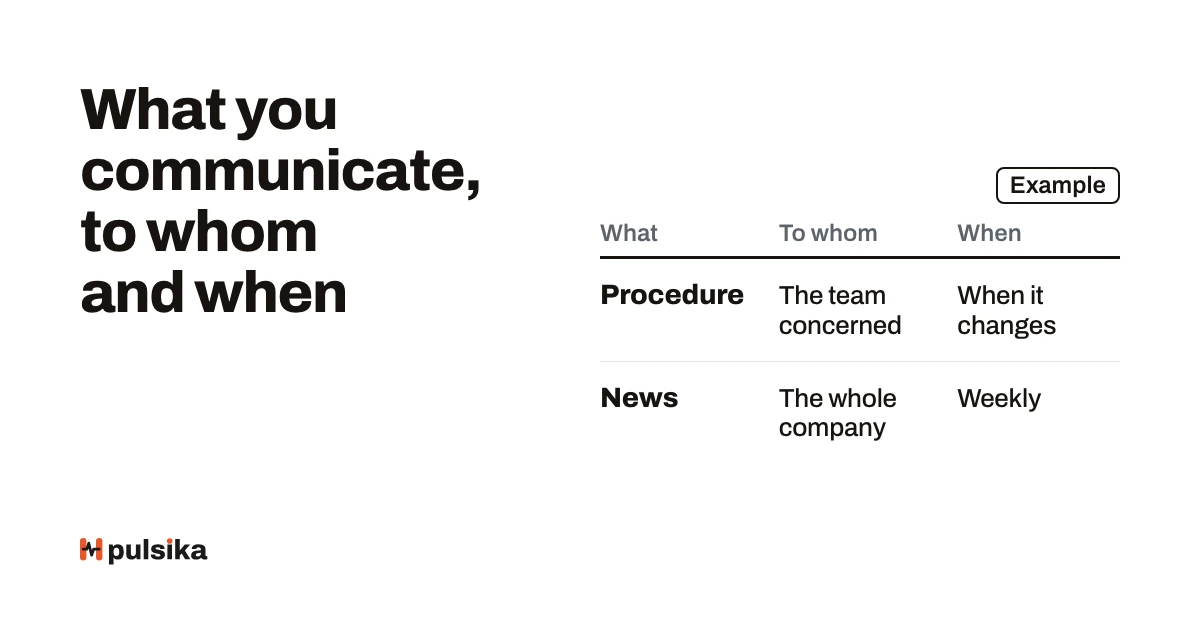
An internal communication plan for a company with several locations sets out, on a single page, who needs to know what, when, on which channel, who sends the message and how you check that it arrived. The difference from a company with a single office: people work in shifts, each unit’s manager becomes a relay, and part of the team does not sit at a computer.
This article gives you the structure of the plan in seven components, an annual–quarterly–monthly–weekly rhythm, a completed example for a fictitious chain of 12 shops, indicators calculated with a numerator and a denominator, and a downloadable XLSX template.
Quick answer. An internal communication plan for several locations has seven components: objectives, audiences, messages, channels, frequency, owners and indicators. Start with the audiences (head office, unit managers, frontline teams), set a predictable rhythm (annual, quarterly, monthly, weekly), give every message an owner and a date, and measure the confirmation rate and participation every month.
What an internal communication plan is
An internal communication plan is the document that links the company’s objectives to the messages sent to employees over a given period, usually a year divided into quarters. It does not replace the rules on which message goes on which channel; it uses them.
- An audience is a group of people who need the same information at the same moment: all employees, unit managers, the teams in one area, the warehouse.
- The key message is the idea the audience needs to remember, written in one sentence, before any other text.
- The channel is the means by which the message arrives: the announcements feed, the start-of-shift briefing, the managers’ meeting, the knowledge base, email.
- The cadence is the fixed frequency of one type of message, so that people know when to expect it.
- The indicator is the figure by which you check that the message arrived: confirmations, views, participation, questions received.
The channel rules (official announcement, team conversation, private message, procedure, emergency) are described separately, in the guide Internal communication beyond chat groups. The plan here assumes you already have them.
What the law requires and what is a management matter
Part of internal communication is a legal obligation, and the rest is a management decision. The distinction matters when you decide what must not be missing from the plan.
- Romania’s Labour Code (Codul muncii), Art. 40(2), requires the employer to inform employees about working conditions and the matters concerning employment relations (letter a), to communicate the unit’s economic and financial situation periodically, at the intervals negotiated in the applicable collective agreement (letter d), and to consult the trade union or the employees’ representatives on decisions likely to affect their rights and interests substantially (letter e) (Law no. 53/2003, consolidated text, checked on 18 October 2026).
- Romanian Law no. 467/2006 applies to undertakings based in Romania with at least 20 employees (Art. 4(1)). Art. 5(1) requires informing and consulting the employees’ representatives on the development of the activity and the economic situation, the development of employment and decisions likely to lead to substantial changes in work organisation (consolidated text, checked on 18 October 2026). The law transposes Directive 2002/14/EC.
The obligations above concern the content and, in the case of consultation, the employees’ representatives. The rhythm of the newsletter, the briefings or the surveys are management choices. How information and consultation are organised in practice in your company (who the representatives are, what the collective agreement provides) is a question for the company’s lawyer.
Caution. For the internal regulations and for occupational health and safety training, the law also requires proof that people were informed. These have their own rules; do not treat them as just another message in the calendar.
The seven components of the plan
The table below shows each component, the question it answers and what it looks like when filled in. The example is fictitious: a chain of 12 shops with a warehouse and a head office, 148 employees.
| Component | The question it answers | Completed example (fictitious data) |
|---|---|---|
| Objectives | What needs to change in behaviour or understanding this quarter? | All shops apply the new returns procedure by 31 March; everyone knows the holiday opening hours two weeks in advance. |
| Audiences | Who needs the information, and in what conditions do they read? | 12 shop managers, 104 people in the shops, 18 in the warehouse, 14 at head office. |
| Messages | What does each audience need to remember, in one sentence? | “Returns are accepted only with the receipt scanned, from 1 February.” |
| Channels | How does the message arrive, and with what fallback? | An announcement in the feed with confirmation; fallback: the start-of-shift briefing. |
| Frequency | When do people expect it? | Monthly news on the first working day; the managers’ meeting every Monday. |
| Owners | Who writes, who approves, who passes it on? | HR writes, the operations director approves, the shop manager presents it at the briefing. |
| Indicators | How do you know it arrived? | Confirmation rate ≥ 90% within 7 days; survey participation ≥ 60%. |
The audiences of a company with several locations
Audiences are defined by how people read, not by the organisation chart. A cashier and an accountant are in the same company, but they receive information at different moments and on different channels.
Unit managers are a separate audience
The manager of a shop, a hotel or a pharmacy passes on almost everything that matters to the team. That is why they receive important messages before the team, a few days ahead (usually 2–5 working days), together with the answers to the likely questions. A manager caught out by an announcement at the same time as the team cannot answer questions.
Frontline teams read at the start of the shift
People in shops, receptions or warehouses do not read during the shift. Messages for them are scheduled before the shift, and every important message has a fallback: the 5–10 minute briefing at the start of the shift or a poster in the staff area.
Head office has constant access, but also the most noise
Office colleagues receive a lot of emails and messages. What matters for them is that official announcements are few and easy to recognise, not mixed in with other notifications.
The rhythm: what you communicate annually, quarterly, monthly and weekly
A fixed rhythm reduces the number of ad hoc messages. People learn that news comes on a particular day, and the owners know what they have to prepare.
| Cadence | What it contains | Who runs it | Suitable channel |
|---|---|---|---|
| Annual | The year’s objectives, last year’s results, the calendar of major events | Senior management | A meeting (in person or online) and a written announcement with the summary |
| Quarterly | Progress on objectives, organisational changes, survey results | Senior management and HR | An announcement in the feed and a discussion at the managers’ meeting |
| Monthly | News, new people, recognition, what is coming next month | HR or communications | A single grouped announcement, on the same day of the month |
| Weekly | Operational priorities, promotions, opening hours | The operations director, area managers | The managers’ meeting, then the briefings in the units |
| Daily | What is happening on today’s shift | The unit manager | The start-of-shift briefing |
| As events occur | A new procedure, a change of hours, an incident | The process owner | An announcement with confirmation, plus the procedure in the knowledge base |
Practical tip. Fix the day, not just the frequency: “the month’s news, on the first working day, at 8:00” is easier to follow than “monthly”. For shift teams, choose a time when the morning shift starts.
How to build the plan in eight steps
- Write 2–4 objectives for the quarter, tied to what needs to change (a procedure applied, a campaign understood), not to the number of messages.
- List the audiences with the number of people in each and how they read (access to a computer, a phone, only the briefing).
- List the mandatory messages: what the law or the collective agreement requires, what has a fixed deadline (holidays, stocktaking, appraisals).
- Add the messages that support the objectives, each with its key message written in one sentence.
- Choose the main channel and the fallback for each message, following the company’s channel rules.
- Put an owner and a date on every row: who writes, who approves, who passes it on in the units.
- Set 3–5 indicators with a numerator, a denominator and a target, and who reads them every month.
- Review the plan at the end of the month: what was done, what was postponed, what questions came in on other channels.
The template internal-communication-plan.xlsx has one sheet each for audiences, the quarter’s plan, the summary by status and measurement, filled in with the example below. The coloured cells are the ones you fill in.
Hypothetical example: the first quarter in a chain of 12 shops
Hypothetical example. The company, the figures and the names are invented. The chain has 12 shops, a warehouse and a head office: 12 shop managers, 104 people in the shops, 18 in the warehouse and 14 at head office, 148 employees in total.
| Month | Message | Audience | Channel | Owner | Confirmation |
|---|---|---|---|---|---|
| January | The year’s objectives and last year’s results | All employees | An online meeting and an announcement with a summary | The managing director | No |
| January | The new returns procedure, presented before launch | Shop managers | The Monday meeting | The operations director | No |
| January | The new returns procedure, from 1 February | Shop teams | An announcement with confirmation, link to the procedure | HR | Yes |
| February | The month’s news: new people, recognition, the March stocktake | All employees | Monthly announcement | HR | No |
| March | The stocktaking schedule by shop | Shops and warehouse | An announcement with confirmation | The operations director | Yes |
| March | The quarterly survey on working hours and equipment | All employees | An anonymous survey, announced at the briefing | HR | No |
The order matters: managers learn about the returns procedure a week before the teams, so that they can answer questions at the briefing. The downloadable file contains the same example, extended to 12 rows.
How to measure whether the plan works
Every indicator has a numerator, a denominator and a period. Without them, “90%” says nothing: 90% of whom, after how many days?
| Indicator | Numerator | Denominator | What it does not tell you |
|---|---|---|---|
| An announcement’s confirmation rate | People who confirmed within 7 days | People who were asked to confirm | Whether they understood; a confirmation does not prove understanding |
| View rate | People who opened the message within 7 days | The message’s audience | Whether they read it to the end |
| Survey participation | People who responded | People it was sent to | How representative the respondents are |
| Briefings held | Briefings held in the month | Briefings planned in the month | What was said at them |
| Clarification questions | Questions about the same announcement received on other channels | No denominator; compared from one announcement to the next | Whether those who do not ask have understood |
Calculation on the fictitious example: the stocktaking announcement asked the 134 people in the shops and the warehouse (12 managers, 104 people in the shops, 18 in the warehouse) to confirm; 120 confirmed within 7 days. The rate is 120 / 134 = 0.896, that is 89.6%, below the 90% target. The quarterly survey was answered by 97 of 148, that is 65.5%, above the 60% target.
Also look at the distribution by unit. An overall rate of 89.6% can hide a shop at 40%, where the briefing is not held or people do not have an account.
Common mistakes
- The plan as a list of channels. A table with “newsletter, group, email” does not say who needs to know what. Fix: start from objectives and audiences.
- Unit managers find out at the same time as the team. Fix: give them the message and the answers to the likely questions a few days beforehand.
- The same text for head office and the front line. Fix: the same key message, adapted to how each audience reads and to the moment in the shift.
- Indicators without a denominator. “120 confirmed” says nothing without “out of 134”. Fix: write both figures and the period.
- Only top-down communication. The plan has no channel through which people can ask or raise an issue. Fix: a quarterly survey, questions collected at the briefing, an owner who replies.
- The plan written once and forgotten. Fix: a 30-minute monthly review, with the statuses in the plan and the indicators.
How to keep the plan in Pulsika
The plan itself remains a team document (the XLSX template above). In Pulsika, the company’s social network covers the channels in the plan:
- Announcements are sent to the whole company, a unit, an area, a department, a job title or a role, can be scheduled and can be pinned to the top until a date.
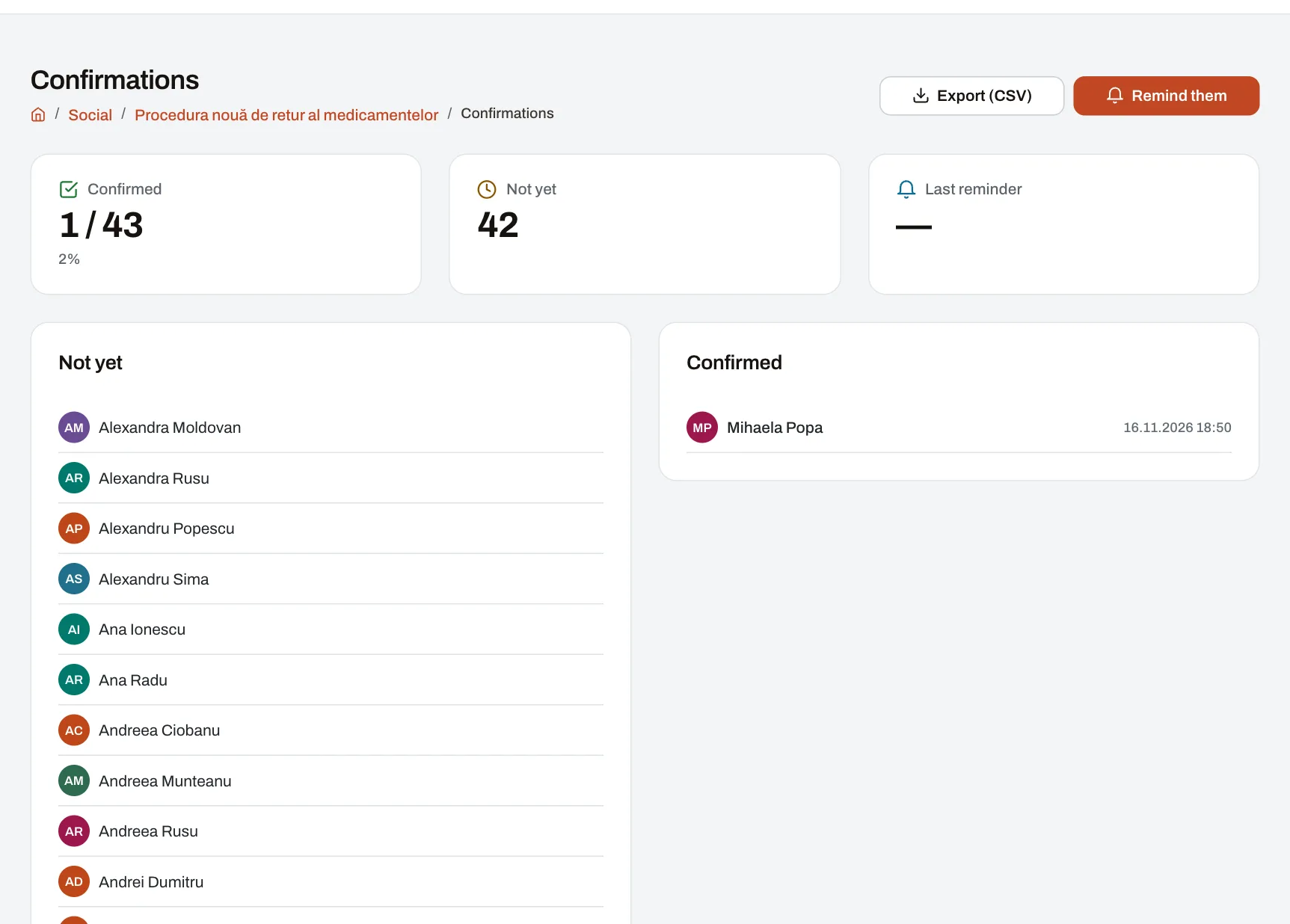
- Read confirmation is requested at publication; the author sees who has confirmed and who has not, exports the list and can send a reminder at most once every 20 hours (polls, events and confirmations).
- Per-post statistics (audience, how many have seen it, reactions, comments) are available on the Professional and Enterprise plans.
- Anonymous surveys show the results after closing and only from 5 responses; procedures live in the knowledge base.
Frequently asked questions
Who writes the internal communication plan?
The plan is usually written by HR or the person responsible for communication, together with the operations director. Senior management approves the objectives, and unit managers check that the rhythm fits the shifts. In a small company, the same person may fill all three roles, but every row in the plan still has an owner’s name.
What period does the plan cover?
The plan usually covers a year, with detail for the current quarter. The year’s major events (appraisals, stocktakes, holidays, campaigns) are entered from the start. The quarter’s messages are detailed a month in advance, and the plan is reviewed monthly, because operations in the units change often.
How many official messages a week are too many?
There is no general threshold. A practical signal: if the confirmation rate falls from one announcement to the next or people ask “which version is the right one”, there are too many. Group the news into a monthly or weekly announcement and keep separate announcements for what calls for action or has a deadline.
What do we do about employees who have no account in the application?
Give them a fallback channel written into the plan: the start-of-shift briefing, a poster in the staff area or a shared device in the unit, with a personal account for each person. The unit manager is responsible for passing messages on and notes who attended the briefings at which important messages were presented.
Is an internal communication plan required by law?
No, the law does not require a document called that. Romania’s Labour Code requires employees to be informed about working conditions and the economic situation to be communicated periodically, and Law no. 467/2006 requires informing and consulting representatives in companies with at least 20 employees. The plan is the tool by which you make sure these obligations do not get lost among the other messages.
How do we measure whether people understood, not just read?
A read confirmation shows only that the person declared they had read it. Understanding is checked separately: a question at the briefing, a short test for important procedures or observation on the job after two or three weeks. The methods are described in detail in the article on launching a new procedure in every location.
Who can publish announcements for the whole company?
Few people: usually HR, senior management and area managers for their area. If anyone can publish for everyone, official announcements get mixed up with the other messages again. Write into the plan who has this right and who approves the text before publication, especially for messages that affect working hours or pay.
What to do next
Download the plan template, replace the example with your own audiences and fill in the first quarter. For the channel rules, read the guide on chat groups; for launching a procedure, the article on procedures understood in every location; and for the quarterly survey, the guide to designing the survey. The feed, confirmations and surveys can be seen in the demo company.