

 Română
 English
 Deutsch
 Magyar
A useful employee satisfaction survey has 12–20 questions, each about one thing only, on a labelled scale, plus 1–2 open questions. It is genuinely anonymous, does not report groups below a minimum number of responses and ends with actions communicated to people. A survey can fail in three places: in the wording, in the anonymity or in what comes after.
The article gives you a question bank on eight topics, examples of poor questions rewritten, a calculation that shows how a single response can be identified from partial results and a work plan from the objective to the report.
Quick answer. Start from the decisions you can take, not from a long list of questions. Use 12–20 questions, one idea each, on a five-point scale with every point labelled, plus one open question. Guarantee anonymity, do not show results below five responses per group, test the survey on a few people and communicate the actions within a month at most.
What an employee satisfaction survey is
An employee satisfaction survey is a fixed set of questions through which the company finds out how people see concrete aspects of their work: the schedule, the manager, the tools, recognition, development, pay. Unlike eNPS, which gives a single score, the survey shows where the problem is.
- The Likert scale is a series of ordered points (for example, from “not at all” to “completely”) on which the respondent marks their position on a statement.
- An anonymous survey is one in which a response cannot be linked to the person who gave it, neither directly nor by combining data.
- A confidential survey is one in which someone can link the response to the person, but promises not to do so and not to show individual responses.
- The minimum reporting threshold is the minimum number of responses below which a group’s results are not shown.
For the recommendation score and its limits, see the article on eNPS and employee satisfaction.
What you want to find out: start from decisions
Every question costs the time of hundreds of people. Before you write one, check that the answer can change a decision: the shift schedule, the equipment, the way recognition is given, the training priorities.
A simple test: next to each question, write “if the result is poor, we will…”. If you cannot finish the sentence, the question does not belong. Questions about things the company cannot or will not change create expectations and then disappointment.
How to word the questions
Pew Research Center, an American survey research institute, recommends asking one question at a time: questions that ask people to rate two things at once are hard to answer and hard to interpret. Pew also shows that the “agree / disagree” format encourages a tendency to agree (acquiescence bias) and that the order of the questions can influence the answers (Pew Research Center, Writing Survey Questions, checked on 18 October 2026).
| Weak question | The problem | A better version |
|---|---|---|
| “Are you satisfied with your manager and your colleagues?” | Two questions in one: an answer of 3 does not say which it refers to | Two separate questions, one about the manager, one about colleagues |
| “Don’t you think the schedule should be changed?” | A negative and a suggested answer | “How well does your current work schedule suit you?” |
| “Communication in the company is good.” (agree / disagree) | Vague and in agree format, which pushes towards “agree” | “In the last month, did you find out in time about the changes that concerned you?” (never … always) |
| “How often do you receive feedback?” | No period and no definition | “In the last 30 days, how many conversations about your work have you had with your direct manager?” |
| “Is your pay fair?” | A loaded term; everyone understands something different by “fair” | “How well do you understand how pay is set for your position?” |
Practical tip. Put the open question (“What should we change first?”) at the end, after the closed ones, and only once. Two or three compulsory open questions make the survey longer to fill in and tend to bring the same answers several times.
Which scale to choose
- Five points are enough for most satisfaction questions and are easy to read on a phone.
- Label every point, not just the ends, so that everyone understands the same thing by 3 or 4.
- Keep the same direction (from negative to positive) throughout the survey, so that people who answer quickly do not make mistakes.
- Add “Not applicable” where the question does not concern everyone (for example, the night shift), outside the scale.
- Use the 0–10 scale only for the eNPS-style recommendation question, where the standard classification requires it.
Question bank on eight topics
Choose 2–3 questions from the topics that concern you. All of them address the respondent formally, like the rest of official communication; adapt them to your company’s register.
| Topic | Question | Scale |
|---|---|---|
| Schedule and workload | “In the last month, how suitable was your workload?” | Far too little … far too much |
| Schedule and workload | “Do you find out the shift schedule early enough to plan around it?” | Never … always |
| The direct manager | “My direct manager tells me clearly what is expected of me.” | Not at all … completely |
| The direct manager | “I can raise a problem without fear of consequences.” | Not at all … completely |
| Tools and information | “I have the equipment I need to do my work well.” | Not at all … completely |
| Recognition | “In the last month, has someone told you specifically what you did well?” | Yes / No |
| Development | “Have you learnt something useful for your work in the last three months?” | Yes / No |
| Team | “My colleagues help me when I need it.” | Never … always |
| Pay and benefits | “How well do you understand how pay is set for your position?” | Not at all … very well |
| Intention to stay | “Do you see yourself working here a year from now?” | Yes / Don’t know / No |
| Open | “What should we change first?” | Free answer |
Avoid fine-grained demographic questions (exact age, exact length of service, a rare job title). They do not help with decisions and make people identifiable.
Anonymous, confidential or named
| Type | Who can link the response to the person | Suitable for | Risk |
|---|---|---|---|
| Anonymous | Nobody, not even the system administrator | Satisfaction, trust in the manager, climate | You cannot go back to whoever reported a serious problem |
| Confidential | Whoever administers the data, who promises not to | Analyses by profile, with clear agreement | Trust depends on who has access; people may answer cautiously |
| Named | Anyone who sees the results | Practical choices (uniform size, schedule preferences) | Unsuitable for questions about the manager or the climate |
What the GDPR says about anonymity
The General Data Protection Regulation does not apply to anonymous information, that is, information that does not relate to an identified or identifiable person. To decide whether someone is identifiable, account is taken of all the means reasonably likely to be used by the controller or by another person (recital 26, Regulation (EU) 2016/679). An “anonymous” response from a shop with six employees, accompanied by age and length of service, may be identifiable.
For surveys that are not anonymous, the legal basis for processing must be settled with the company’s lawyer. The European Data Protection Board considers it problematic to process employees’ data on the basis of consent, because of the imbalance of power between employer and employee (Guidelines 05/2020, paragraphs 21–22, EDPB).
The minimum number of responses and subtraction between reports
The minimum threshold protects small groups, but it is not enough on its own. The risk also appears when you compare two reports that differ by a single response.
Hypothetical example. An area has 11 responses to the question about the area manager, with an average of 4.0, that is, a total of 44. After one more person answers, the report shows 12 responses and an average of 3.75, that is, a total of 45. The new response is 45 − 44 = 1. If you know who filled it in last, you know what they answered.
- Do not show partial results while the survey is open; publish them once, after it closes.
- Set the threshold in advance (5 responses is a common convention, not a legal rule) and apply it to every breakdown: unit, shift, length of service.
- Do not combine filters that together drop below the threshold (“shop X, night shift, under a year’s service”).
- Show free-text answers shuffled, not in the order received, and read them before publishing for names or identifying details.
How to run the survey, step by step
- Write down 2–3 decisions you will take on the basis of the results and who takes them.
- Choose 12–20 questions from the bank, plus one open question. Target completion time: under 10 minutes.
- Test the survey on 5–8 people in different roles, asking them to say out loud how they understand each question. Pew describes pretesting as a basic step in designing a survey.
- Announce the survey: why you are running it, how long it takes, who sees what, when it closes and when you will communicate the results.
- Keep it open for 10–14 days, to catch every shift and short leave; give field teams time to fill it in during working hours.
- Send a single reminder, 2–3 days before it closes.
- Close and report: the response rate, the results per question, the groups above the threshold and the themes in the free-text answers.
- Communicate 1–3 actions within a month of closing at most, and say what cannot be changed and why.
Calculating the response rate, on a fictitious example: the survey was sent to 148 people and 97 answered; the rate is 97 / 148 = 65.5%. Report it by unit, with the threshold respected: a rate of 20% in one unit makes the results there barely representative.
Common mistakes
- A long survey, “so we find out everything”. The last questions get rushed answers or none at all. Fix: 12–20 questions, tied to decisions.
- A promise of anonymity without a technical guarantee. If the link is personal and the results are visible straight away, people do not believe the promise. Fix: explain concretely how anonymity is protected.
- Results for groups that are too small. Fix: a minimum threshold, applied to every breakdown.
- Double or negative questions. Fix: one idea per question, worded positively.
- Hunting for the author of a comment. It destroys trust for every future survey. Fix: deal with the theme, not the person.
- No action communicated. People no longer have a reason to answer next time. Fix: 1–3 actions, with an owner and a deadline.
How to run the survey in Pulsika
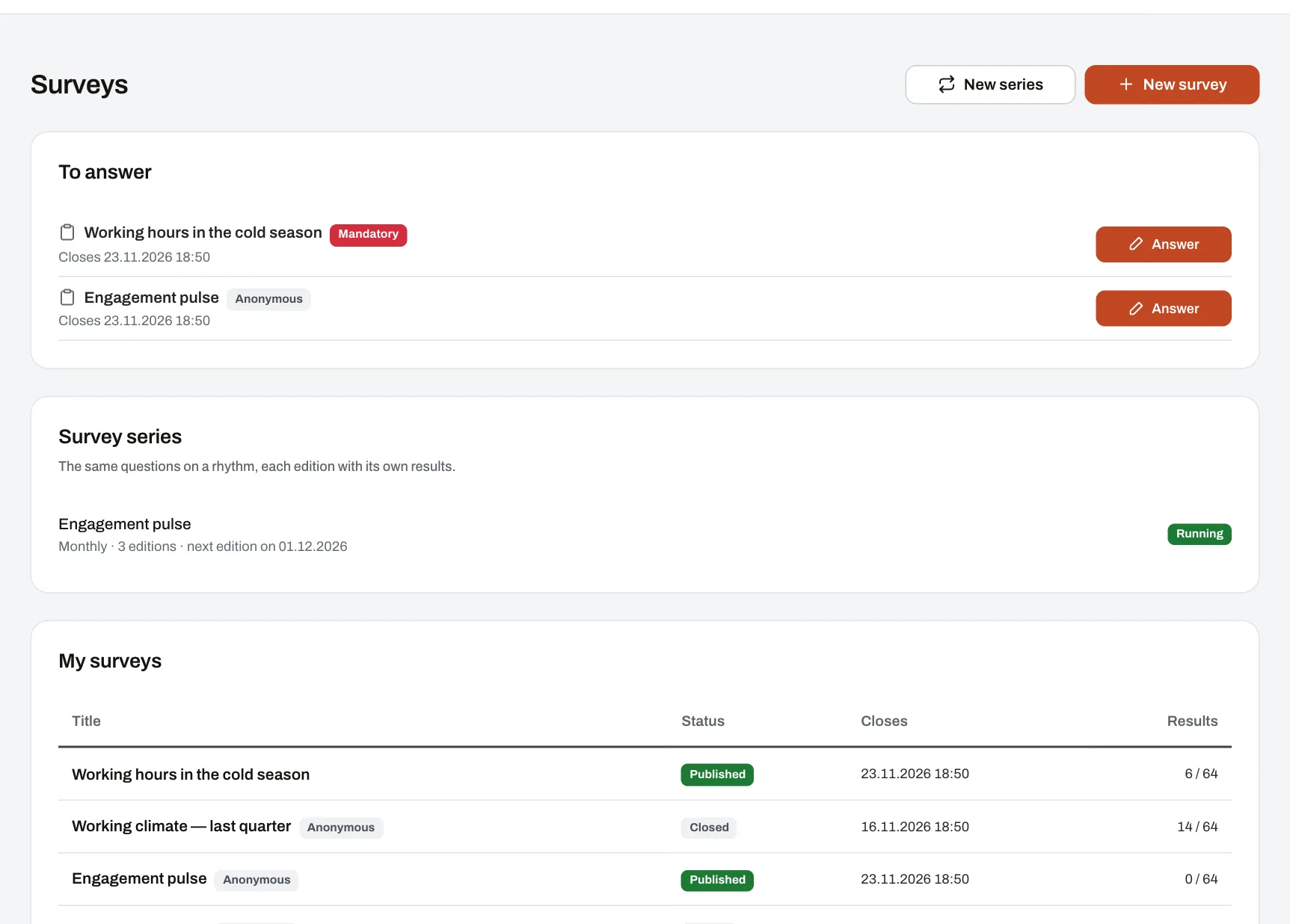
In Pulsika, surveys cover the steps above:
- Question types: one option, several options, free text and a 1–5 scale, with the ends labelled “not at all” and “very much”. For a scale with every point labelled (“never … always”), use a one-option question with five options. The eNPS question is asked as a one-option question with 11 options from 0 to 10; the results show how many answers each option has.
- Audience: the whole company, a unit, a department, a position or an area; the participants are set when you publish, and the questions can no longer be changed after that.
- Anonymity: anonymous answers stay sealed until the survey closes and are then written all at once, in random order. Results appear only after closing and only from 5 responses; the author sees who has answered, but not what they answered.
- Mandatory surveys: a banner until the survey is filled in and a reminder before the deadline, for those who have not answered.
- Free-text answers appear in random order in anonymous surveys; after closing, an AI summary of the themes can be generated, if the subscription includes the AI assistant and the company has switched it on.
Frequently asked questions
How many questions should a satisfaction survey have?
A satisfaction survey works well with 12–20 closed questions and one open question, filled in in under 10 minutes. More questions lower the completion rate, especially on a phone and during a shift break. If you need more topics, split them across two surveys, a few months apart.
How often should we run the satisfaction survey?
A full survey is usually run once or twice a year, with time between them for actions. In between you can use a short eNPS-style question every quarter. Do not repeat the full survey more often than you can communicate the results and the changes made after the last one.
Which scale is best?
The five-point scale, with every point labelled, is enough for most satisfaction questions and is easy to read on a phone. Keep the same direction throughout the survey and add “Not applicable” separately. The scale from 0 to 10 is used for the recommendation question, where the eNPS classification requires it.
What minimum number of responses should we use?
A threshold of 5 responses per group is a common convention, not a legal requirement. Choose the threshold in advance, apply it to every breakdown and do not show partial results while the survey is open. For very sensitive questions or groups with easily recognisable people, a higher threshold gives more protection.
Does an anonymous survey fall under the GDPR?
Truly anonymous information does not fall under the regulation, according to recital 26 of the GDPR. A survey is anonymous only if nobody can reasonably identify the person from the responses, including by combining demographic data or through successive reports. If there are identifying data, apply the data protection rules and settle the legal basis with the company’s lawyer.
Can the survey be mandatory?
You can ask people to fill it in, but an imposed satisfaction survey often produces hurried answers. If you make it mandatory, give time to fill it in during working hours and do not link the answers to the appraisal or the bonus. For named surveys, check the legal basis for processing with the company’s lawyer, especially since the EDPB considers employees’ consent rarely freely given.
What do we do with negative comments about a manager?
Deal with the theme; do not look for the author. If several comments describe the same behaviour, discuss it with the manager and with their superior, without quotations that could identify anyone. If a comment describes harassment or a danger, apply the internal reporting procedure and tell everyone how a named report can be made.
What to do next
Write down the 2–3 decisions you want to take and choose the questions from the bank. For the recommendation question and how to read the score, read the article on eNPS; for one-to-one conversations with key people, the stay interview; for where the survey sits in the year’s calendar, the internal communication plan. Anonymous surveys can be seen in the demo company.