

 Română
 English
 Deutsch
 Magyar
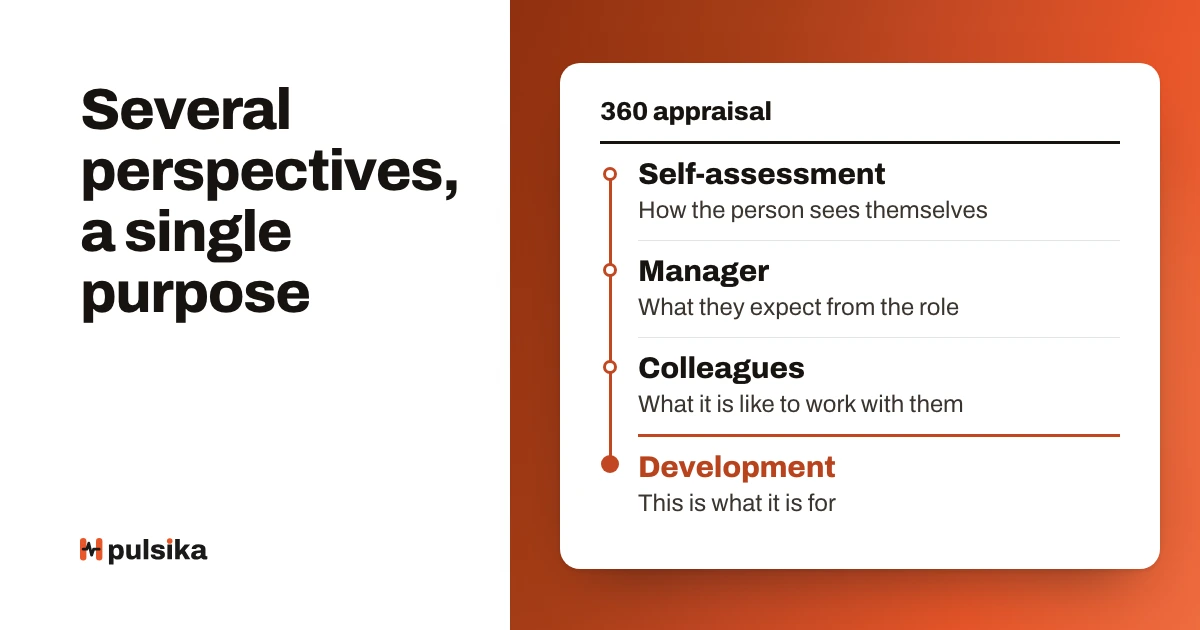
A 360-degree appraisal gathers, on the same questions, the views of a person’s manager, colleagues, direct reports and sometimes customers on that person’s behaviour, alongside their own self-assessment. It is most useful for developing people whose work is seen by many others, such as managers and coordinators, and it works only with real anonymity and questions about observable behaviour.
This guide helps you decide whether you need one, how to choose the raters, which anonymity threshold to use, how to rewrite vague questions and how to read a report, with a calculation that shows why the way you average matters.
Quick answer. A 360-degree appraisal compares a person’s self-assessment with the ratings of their manager, colleagues, direct reports and, sometimes, customers, on the same behaviours. Use it for development, not for pay. Ask for at least three responses per group to keep anonymity, write questions about observable behaviour and turn the report into one or two development goals.
Definitions
- The 360-degree appraisal (multi-source feedback) is a process in which a person receives structured ratings from several groups who work with them and compares them with their own rating.
- The person appraised is the person the process is run for. They receive the report.
- The rater groups are the direct manager, peers at the same level, direct reports and, optionally, internal or external customers.
- The anonymity threshold is the minimum number of responses from a group below which the group’s results are not shown separately.
- The 360 report consists of the results by question and by group, the difference between the self-assessment and the others, and the written comments, without names.
When a 360 appraisal is useful and when it is not
| Situation | Recommendation | Why |
|---|---|---|
| Managers and coordinators with at least 3 direct reports | Suitable | Direct reports see behaviour that the manager above does not see |
| Roles that link departments | Suitable, with colleagues from other teams | Collaboration is easier to see from outside the team |
| Bonus or pay decisions | Unsuitable as the main source | Research finds ratings more affected by bias when the results influence administrative decisions |
| A team of 3–4 people | Only with merged groups | The anonymity threshold cannot be met group by group |
| A team in open conflict or being restructured | Postponed | Responses become weapons; resolve the conflict first |
| A new employee, under 6 months in the role | Postponed | The raters have not seen them enough in different situations |
Development or administrative decisions?
A meta-analysis of 24 longitudinal studies (Smither, London and Reilly, Personnel Psychology, 2005) found that the improvement in ratings after multi-source feedback is generally small. The authors warn that a large, widespread improvement should not be expected.
The effects were larger when the feedback was used for development only: an average effect size of 0.25, against 0.08 when the results could influence the annual appraisal, pay or promotion. The authors urge caution, because few studies had an administrative purpose. They also show that improvement is more likely when the person sets goals and does something concrete: discusses the results, works with a coach, takes part in development activities.
Remember. State from the start, in writing, what the results are used for and who sees them. If the purpose is development, the report goes to the person appraised and to whoever helps them interpret it, not into the pay file.
Who rates and how many raters you choose
- The person appraised proposes the raters and the manager approves the list. That way you avoid both a list of friends and the impression that the manager picked the “accusers”.
- The raters have worked with the person long enough to have seen the behaviours asked about; a practical rule is at least three months of working together.
- Three to five raters per group for peers and direct reports. There is only one direct manager, so their response is not anonymous; say so openly.
- Limit the load: someone who has to fill in ten questionnaires in the same week answers in a hurry. Set a maximum, for example five per cycle.
How to protect anonymity
Anonymity is not a promise but a set of technical rules. The Center for Creative Leadership (CCL), for example, requires a minimum number of raters in each category to protect anonymity; the exact threshold differs from one instrument to another.
- A threshold per group. Below three responses, the group’s results are not shown separately; they are merged with another group (for example peers and internal customers) or appear only in the total.
- No distribution of responses when the group is small. With three responses, showing that one person gave a 1 exposes them.
- Comments are shown without names and in no order that would give away the source. Tell raters that their style and details can identify them.
- Nobody in the company sees the individual responses, neither HR nor the manager. If the tool cannot guarantee this, say what each person sees.
Responses about a person are that person’s personal data. The General Data Protection Regulation gives them the right of access to the data concerning them and to a copy, but this right must not adversely affect the rights and freedoms of others (Regulation (EU) 2016/679, Art. 15(1), (3) and (4)), that is, of the raters. Agree with your data protection officer or your lawyer how you will answer such a request before the first cycle.
How to word the questions
A good question describes a behaviour the rater has been able to see. Use a frequency scale (1 = never, 5 = always) and a “not observed” option that does not count in the average. Between 15 and 25 closed questions and two open questions are enough.
| Weak wording | The problem | Better wording |
|---|---|---|
| “Is a good communicator.” | A trait, not a behaviour; everyone understands something different | “Explains the reasons for decisions that affect the team.” |
| “Listens to and takes colleagues’ views into account.” | Two behaviours in a single question | “Lets others finish before replying.” |
| “Does not avoid conflict.” | A negative, hard to rate on a scale | “Discusses a disagreement directly with the person involved.” |
| “Has strategic vision.” | Peers and direct reports cannot observe it | “Links the team’s tasks to the unit’s goals.” |
| “Is this the best manager you have had?” | A comparison and a question that suggests the answer | “Gives concrete feedback after an important task.” |
The two open questions that usually yield the most material: “What should they keep doing?” and “What should they do differently to be more effective?”.
How to read the report: a calculation
Hypothetical example. Fictitious data. On the question “Gives concrete feedback after an important task”, a unit manager receives the following ratings: self-assessment 5; their manager 4; peers 3, 3 and 4; direct reports 2, 2, 3, 4 and 4.
- Average by group: peers (3 + 3 + 4) ÷ 3 = 3.33; direct reports (2 + 2 + 3 + 4 + 4) ÷ 5 = 3.00; manager 4.00.
- “Others” average as the average of the groups: (4.00 + 3.33 + 3.00) ÷ 3 = 3.44.
- “Others” average as the average of all ratings: (4 + 3 + 3 + 4 + 2 + 2 + 3 + 4 + 4) ÷ 9 = 29 ÷ 9 = 3.22.
- The gap from the self-assessment: 5 − 3.44 = 1.56 or 5 − 3.22 = 1.78, depending on the convention.
The first convention gives each group the same weight; the second gives weight to the larger group, here the direct reports. Neither is “correct”; choose one, write it in the report and keep it from one cycle to the next.
The direct reports’ average of 3.00 hides a split: two ratings of 2 and two of 4. Some get feedback, others do not. The useful question for the conversation is “who am I not giving feedback to, and why?”, not “how do I raise the rating?”. With five responses, the distribution can be shown without exposing anyone; with three, it cannot.
What comes after the report
- An interpretation conversation with the manager or a trained HR specialist, within 1–2 weeks of the report. The aim: which themes recur, what is surprising, what the person chooses to change.
- One or two development goals, entered in the individual development plan, with actions and evidence.
- A short message to the raters from the person appraised: thank you, I have understood X, I am working on Y. Raters who see no follow-up stop answering honestly next time.
- Follow-up in one-to-one meetings and a new appraisal after 12 months, with the same questions.
How to run a 360 cycle in eight steps
- Write down the purpose (development), who sees the report and how the data are kept.
- Choose the behaviours to be rated, linked to the company’s values or skills, and write the questions following the rules above.
- Test the questionnaire on 3–4 people: does everyone understand each question the same way? How long does it take to complete?
- Set the raters: the proposal of the person appraised, the manager’s approval, the anonymity threshold per group.
- Explain to the raters how to fill it in, what “not observed” means and how anonymous their response is.
- Collect the responses within 2 weeks, with one reminder. Check the thresholds before the reports are generated.
- Deliver the report in a conversation, not by email without context.
- Follow up the goals and repeat after 12 months.
Caution. If 360 results will ever feed into decisions about pay, promotion or ending the contract, the criteria and procedure for professional appraisal must appear in the internal regulations under Romania’s Labour Code (Codul muncii, Art. 242(i), checked on the Legislative Portal). Talk to your lawyer before changing the purpose.
Common mistakes
- The same questionnaire for every role. Direct reports cannot rate “negotiating with suppliers”. Fix: the questions match what each group sees.
- Anonymity promised but not kept. A group of two peers shown separately is not anonymous. Fix: a threshold of three, merging below it.
- The report sent without a conversation. The person reads the harshest comments alone and becomes defensive. Fix: an interpretation conversation.
- Too many questions. Above 40 questions, raters tick boxes at random. Keep 15–25.
- Using it for the bonus from the first cycle. Fix: development first, and any change of purpose is announced and prepared legally.
- No follow-up. Without goals and a message to the raters, the next cycle gets fewer and more cautious responses.
Rater biases (leniency, the halo effect, recency) appear here too; the guide on errors in employee appraisal explains them one by one.
Frequently asked questions
What is a 360-degree appraisal?
A 360-degree appraisal is a process in which an employee receives structured feedback, on the same questions, from their manager, colleagues, direct reports and sometimes customers, and compares it with their own self-assessment. The result is a report by group and by behaviour, usually used for the development of the person appraised.
How many raters are needed?
Plan for three to five raters for each group of peers or direct reports, plus the direct manager and the self-assessment. Below three responses in a group, the group’s results should not be shown separately, so that the author cannot be guessed. A total of 8–12 raters is generally enough for a useful report without overloading the team.
Is a 360 appraisal really anonymous?
It is anonymous only if the rules make it so: a minimum number of responses per group, merging small groups, comments without names and nobody in the company with access to the individual responses. The direct manager’s response cannot be anonymous, because there is only one of them. Tell the raters exactly what can and cannot be seen.
Can a 360 appraisal be used for bonuses?
It can, but it is not recommended as the main source. The 2005 meta-analysis by Smither, London and Reilly found larger improvements when the feedback was used for development only. A study cited by the same authors (Greguras and colleagues, 2003) found that ratings collected for administrative purposes are more affected by bias. If you use it anyway, the procedure must appear in the internal regulations.
How often is a 360 appraisal done?
Once a year is a practical rhythm for development. Behaviour changes slowly, and a shorter interval leaves no time for action and tires the raters. Between cycles, follow up the goals in one-to-one conversations. For a manager new to the role, wait at least six months before the first appraisal.
Who sees the 360 report?
The person appraised sees the full report, and whoever helps them interpret it, the manager or an HR specialist, sees it only if that was announced from the start. When the purpose is development, the report does not go into the pay file. Write the rule down before launch and do not change it for the current cycle.
What do you do with an offensive comment?
Do not change it quietly; set a rule in advance. One option: comments with insults or with information about other people are removed by whoever runs the process, and the person appraised is told that a comment was removed. The rule is communicated to raters before they fill in the questionnaire, so they know what happens.
What to do next
Start with a pilot group of 5–10 managers, with a declared development purpose, and rewrite the questions following the table above. The goals that come out of it go into the individual development plan. If you are interested in a questionnaire for the whole company rather than for one person, read the guide on the employee satisfaction survey; for the follow-up conversations, the guide on one-to-one meetings.