

 Română
 English
 Deutsch
 Magyar
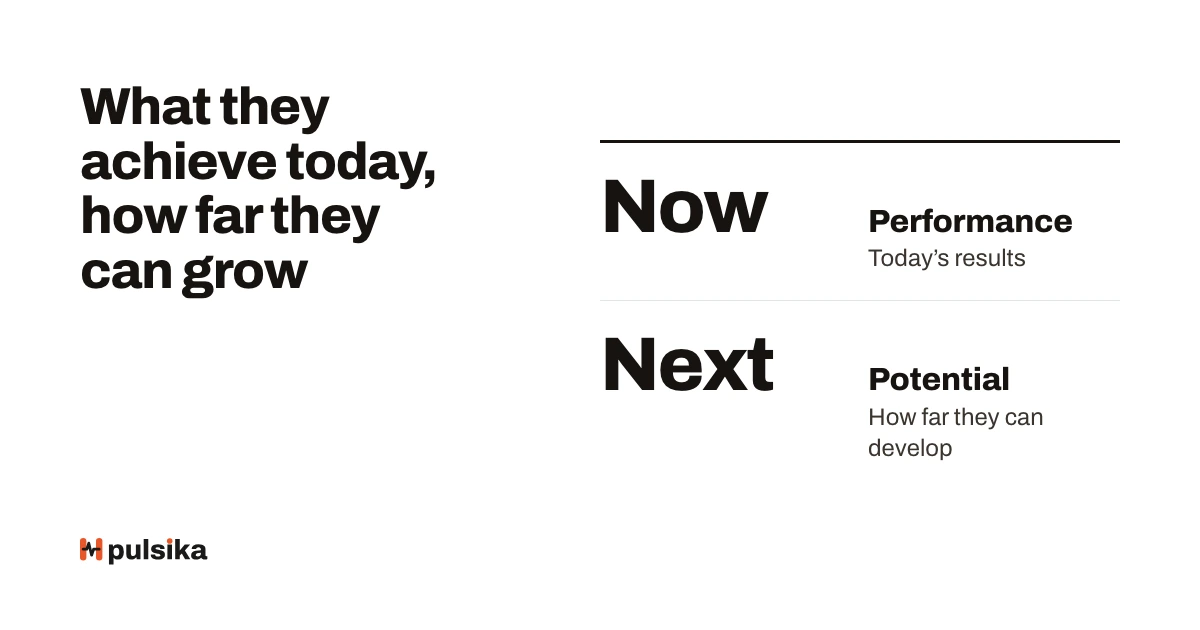
Performance describes what a person has achieved in their current role, over a past period, and rests on data. Potential is an estimate of how well they would cope with a bigger or different role, in the future, and rests on observed behaviours. The 9-box grid puts the two side by side, so you can see what to propose to whom.
The guide separates the two evaluations, proposes four observable indicators of potential, with what does not count as evidence, shows a grid completed for 12 people (fictitious data) and describes the cases in which a placement should not be made at all.
Quick answer. Performance measures the results in the current role; potential estimates the capacity to succeed in a more complex role. The 9-box grid combines three levels of performance with three of potential and helps with development and succession decisions. It is a judgement, not a measurement: it needs written criteria, evidence, calibration between managers and an annual review.
Definitions: performance, potential, 9-box
- Performance is the degree to which a person achieves the results and behaviours required by the current role, over a closed period. Its sources are the indicators, the manager’s evaluations and, where they exist, colleagues’ feedback.
- Potential is the likelihood that a person will succeed in a role with greater responsibility or of a different kind, over a horizon of 1–3 years. It is always potential for something: for leading a team, for a specialist role, for running a unit.
- The 9-box grid is a 3 × 3 table, with performance on one axis and potential on the other. Each person lands in one of the nine boxes, and the box suggests the type of decision.
- The talent review is the meeting in which managers discuss the placements, correct them on the basis of evidence and agree the actions.
How performance differs from potential
| Aspect | Performance | Potential |
|---|---|---|
| What it describes | The results in the current role | The capacity to succeed in a future role |
| Horizon | Past: the last 6–12 months | Future: 1–3 years |
| Source | Indicators, the scorecard, evaluations | Behaviours observed in new situations, the person’s aspirations |
| How certain | Fairly certain, if the data are complete | Uncertain; it changes with the person and with the target role |
| What it decides | Recognition, bonus, improvement plan | Accelerated development, rotations, succession |
| What is communicated | The score and its explanation | The development actions, not the label |
Confusing the two has a documented cost. A study of salespeople’s data from 214 firms found that firms promote on the basis of performance in the current role, at the expense of other characteristics that better predict success as a manager (Benson, Li and Shue, NBER, 2018). The phenomenon is known as the Peter principle.
How to set the performance axis
The performance axis should be the most solid part of the grid. Use the data the company already has and set the rule before the meeting.
- The period: at least two closed evaluation periods, for example the last four quarters. A single weak or exceptional quarter moves nobody.
- The thresholds: three levels tied to the evaluation form’s scale: below expectations, meets expectations, exceeds expectations. Write down the numerical threshold for each.
- Missing data: a person without sufficient data does not get the “below expectations” level, but “to be assessed”. The guide on missing data in evaluation describes the rules.
- Explainability: each person should be able to see where their score comes from; see scores people trust.
How to evaluate potential on observable behaviours
The specialist literature has no single definition of potential. The version below is a working convention: four indicators, each marked 0 (not seen), 1 (seen occasionally) or 2 (seen repeatedly, in different situations). The sum ranges from 0 to 8: 0–3 low potential, 4–5 medium, 6–8 high. Adapt the indicators to the target role.
| Indicator | What you observe | What is not evidence |
|---|---|---|
| Aspiration | The person says they want the target role and accepts what comes with it: hours, relocation, responsibility | The manager’s assumption that they “surely want it” |
| Learning in new situations | Takes on an unfamiliar task quickly, asks for feedback, does not repeat the same mistake | Length of service; courses attended |
| Judgement in unclear situations | Takes reasonable decisions when the procedure does not cover the case, and explains why | Never making a mistake in routine tasks |
| Influence without authority | Colleagues follow or consult them without them being their boss | Extroversion; talking a lot in meetings |
For each mark of 2, the manager writes a concrete example, with an approximate date. Without an example, the mark stays 1. The rule reduces the halo effect, through which good performance “leaks” into the potential mark; the guide on errors in evaluation describes other distortions as well.
Remember. Potential without aspiration does not turn into succession. A person who does not want a leadership role may have high potential for a specialist role; write down the role for which you are making the estimate.
The 9-box grid: what each box means
The names of the boxes vary from one company to another. The table uses neutral descriptions and the typical decision for each area.
| Performance \ Potential | Low | Medium | High |
|---|---|---|---|
| Exceeds expectations | Trusted expert: keep them in the role, give them trainer roles | Strong contributor: broaden the role, test a new responsibility | Succession candidate: an accelerated development plan, a trial role |
| Meets expectations | Steady contributor: development in the role, no pressure to move up | The core of the team: development objectives in the current role | Growing: new projects, a mentor, check what is holding back the results |
| Below expectations | At risk: an improvement plan and a clear conversation | Struggling: find the cause (new role, support, fit) | Possibly the wrong role, or too new: check the fit and the support before any conclusion |
An example: the grid completed for 12 people
Hypothetical example. Fictitious data. A retail chain with four stores holds a talent review for 12 coordinators and senior consultants. Performance comes from the scorecard over the last four quarters; potential, from the four indicators above, for the role of store manager.
| Performance \ Potential | Low (0–3) | Medium (4–5) | High (6–8) |
|---|---|---|---|
| Exceeds expectations | 1 — Cosmin (2) | 2 — Bianca (4), Mircea (5) | 1 — Andrei (7) |
| Meets expectations | 3 — George (3), Horia (1), Nicoleta (2) | 2 — Emil (5), Flavia (4) | 1 — Diana (6) |
| Below expectations | 1 — Laura (3) | 0 | 1 — Irina (6) |
The total by row: 4 + 6 + 2 = 12 people. The figure in brackets is the potential mark, out of 8. The grid suggests different decisions for each area:
- Andrei and Diana are the candidates for a store manager post. Each gets a three-month trial role (standing in for a manager on leave) and a mentor.
- Cosmin has the best results, but a mark of 2 for leadership potential. Promoting him to manager would be exactly the situation described by the Peter principle. The decision: a trainer role for new consultants and recognition for his results.
- Irina has been in the role for 5 months: she has only one full quarter, and that was a settling-in quarter. Her manager proposed “below expectations”, but the performance axis rule requires at least two closed periods. The meeting’s decision: the placement is cancelled, Irina is marked “to be assessed”, with a new review in six months, and she gets support in her current role.
- Laura gets a clear conversation about her results and an improvement plan, separate from the talent review.
Look at the distribution: 3 people out of 12 (25%) appear in the high potential column, and one of them, Irina, has had her placement cancelled. There is no correct proportion. If half the people appear there, the criteria are too broad; if nobody does, perhaps the criteria are too narrow or the managers have not observed people in new situations.
The limits of the 9-box grid
- Potential remains an estimate. Two managers can rate the same person differently. Without calibration between managers, the grid shows mainly how generous each manager is.
- Labels stick. A box communicated as a label (“low potential”) can influence which tasks the person gets, and therefore what opportunities they have to show something else. Communicate the actions, not the box.
- The grid does not explain why. Two people “below expectations” can have opposite causes: a new role, a health problem, a manager who did not support them.
- Small teams distort. In a team of four people, relative comparisons make no sense. Place people by absolute criteria.
- The grid is annual, people are not. A placement from a year ago may be out of date. Each placement has a date and is reviewed.
What the law says about evaluation criteria
The 9-box grid is not required by law. Romania’s Labour Code (Codul muncii, Law no. 53/2003, checked on the Legislative Portal on 18 October 2026) does, however, set a few rules for any professional evaluation:
- The employer has the right to set individual performance objectives and the criteria for evaluating their achievement (art. 40(1)(f)).
- The person hired is informed, before the contract, about the criteria for evaluating professional activity that apply at the employer (art. 17(3)(e)).
- The internal regulations contain the criteria and procedures for the professional evaluation of employees (art. 242(i)).
The placements in the grid are the employee’s personal data. The General Data Protection Regulation gives the person the right of access to the data concerning them and to a copy of it, without adversely affecting the rights of others (Regulation (EU) 2016/679, Art. 15(1), (3) and (4)). Write the potential notes as if the person were going to read them. If the placement influences promotions or bonuses, check with the lawyer what needs to appear in the internal regulations.
How to organise the talent review in seven steps
- Set the target role for estimating potential (for example, store manager) and the thresholds for performance.
- Send the preparation sheet to the managers: the four indicators, with a mandatory example for each mark of 2.
- Gather the performance data over the same period for everyone; mark as “to be assessed” those without sufficient data.
- Hold the calibration meeting: each manager presents their placements, the others ask for evidence. Move people only on the basis of examples.
- Agree the actions for each person: development, a trial role, an improvement plan or nothing in particular.
- Communicate the actions to each person, in the individual conversation, and link them to the individual development plan.
- Review after 6–12 months: who moved up, who left, which placements turned out to be wrong. Adjust the criteria.
Practical tip. Keep a column on the preparation sheet for “the role for which I am estimating potential”. When a manager writes “any role”, ask them to choose one; the estimate becomes more concrete and easier to discuss.
Common mistakes
- Potential inferred from performance. The best salesperson automatically gets “high potential”. Correct it: mark potential separately, on indicators, with examples.
- The label communicated instead of the actions. Correct it: the person learns what they are developing and what opportunities they get, not which box they are in.
- Placements without evidence. Correct it: no mark of 2 without a concrete example.
- New people placed like everyone else. Correct it: with fewer than two periods of data, “to be assessed”.
- The grid used for dismissals. The grid is not an evaluation procedure for disciplinary measures or dismissal; there, the rules of Romania’s Labour Code apply, with the lawyer.
- No review. Correct it: date the placements and check every year how many were confirmed.
Frequently asked questions
What is the 9-box grid?
The 9-box grid is a three-by-three table that combines three levels of performance with three levels of potential. Each employee lands in one of the nine boxes, and the box suggests the type of decision: accelerated development, keeping them in the role, an improvement plan. The grid serves development and succession discussions; it does not replace performance evaluation and is not an exact measurement.
How is an employee’s potential measured?
Potential is not measured directly; it is estimated from behaviours observed in new situations and from the person’s aspirations. A practical method marks a few indicators, such as aspiration, learning in new situations, judgement in unclear situations and influence, each with concrete examples. Some companies also use psychometric tests or assessment centres, run by specialists.
Does an employee with high performance also have high potential?
Not necessarily. Performance shows success in the current role, and the next role may require other skills, for example leading people instead of selling. A 2018 NBER study of salespeople in 214 firms found that firms promote on current performance, even though other characteristics better predict success as a manager.
Do you tell employees which box they are in?
Communicate the actions and the reasons for them, not the label. The person needs to learn what they are developing, what opportunities they get and what the decision is based on. The placement remains, however, personal data the employee can ask to access, under the GDPR (Art. 15). Write the notes so that you can show and explain them without embarrassment.
How often is the talent review held?
A practical rhythm is once a year, after the performance evaluations close, with a mid-year check for succession candidates. More often does not usually bring new data about potential. Less often turns the placements into old labels. Date each placement and review it at the next talent review.
Does the 9-box grid work in a small company?
It works in part. As a rough guide, below 15–20 people, relative comparisons between boxes lose their meaning, and each person’s placement becomes an individual conversation. Keep the two questions separate, current performance and potential for a specific role, and drop the formal meeting. The nine-box table can remain just a working tool for the manager.
What do you do with a new employee or one back from long leave?
Do not place them on the performance axis until they have at least two full evaluation periods in the role. Mark them “to be assessed”, with the date of the next review. Otherwise, the lack of data shows up as poor performance, and an absence protected by law, such as maternity or sick leave, ends up putting them at a disadvantage.
What to do next
Before the first talent review, write down the target role and the four potential indicators, then try the grid on a single team. For the meeting in which managers compare their placements, use the guide on calibrating evaluations; for the actions that follow, the individual development plan; and for a picture of the skills in a team, the skills matrix.