

 Română
 English
 Deutsch
 Magyar
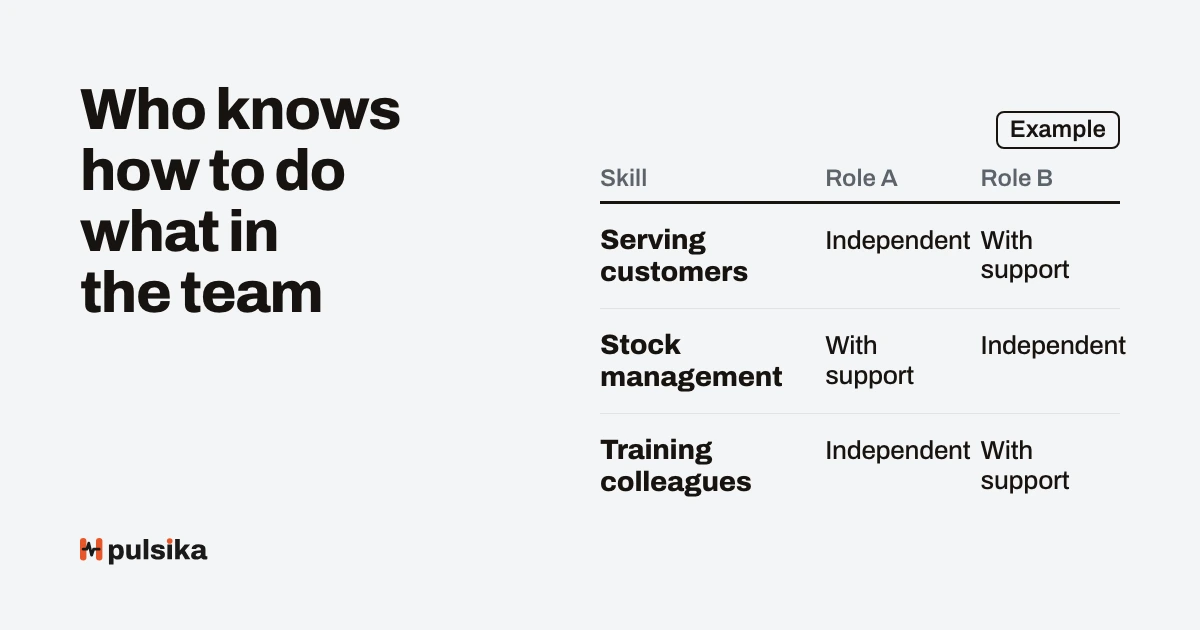
A skills matrix is a table with the team’s people in the columns and the skills the team needs in the rows, and each cell holds that person’s level, checked on a common scale. It shows you three things: which skill nobody has, which critical skill depends on a single person and who needs to learn what.
This guide gives you a 0 to 4 scale with a way of checking each level, a rule for the minimum number of people per skill, a worked example for a hotel reception desk (fictitious data) and an Excel template ready to fill in, with formulas.
Quick answer. A skills matrix sets the team’s people against the skills it needs and records each person’s level on a common scale, usually 0–4. For each skill, set the required level and how many people must have it. The matrix shows the gaps, the critical skills that depend on a single person and the order in which to train people.
What a skills matrix is
- The skills matrix is a skills × people table in which each cell holds one person’s level in one skill, assessed on a common scale.
- A skill, in the sense of the matrix, is an observable task or set of tasks the person can do: “closes the day in the hotel system”, not “customer focus”.
- The required level is the level from which someone can do the task alone, without supervision. On the scale below, usually 3.
- The minimum number of people is how many people must have the required level for the team to keep working through shifts, leave and departures.
- The coverage of a skill is calculated as people at level ÷ minimum people, capped at 100%.
- Dependency risk (in the language of technical teams, the “bus factor”) measures how many people must be away for an activity to stop. A critical skill held by a single person has this number equal to 1.
Which skills go into the matrix
Start from what the team does, not from a general catalogue. Good sources are job descriptions, written procedures, the list of tasks in an ordinary week and the incidents of the past year.
- Between 8 and 15 skills per team are usually enough. Above 20, the matrix stops being kept up to date.
- Phrase each one as an observable task, with a verb: “issues and corrects invoices”, “resolves a complaint at reception”.
- Mark the critical skills: those whose absence stops the work, creates a risk for customers or has legal consequences.
- Use a common vocabulary when you have several locations. The European classification ESCO, also available in Romanian, describes more than 3,000 occupations and almost 14,000 skills and can help you with the wording.
Romania’s Labour Code (Codul muncii, Law no. 53/2003) provides that vocational training and the assessment of knowledge are based on occupational standards (Art. 192(2), checked on the Legislative Portal on 18 October 2026). An internal matrix does not replace an occupational standard or a qualification; it is a tool for organising the team.
The level scale and how you check each level
The scale below has five steps. It resembles the Dreyfus brothers’ model of skill acquisition (from novice to expert), but it is a practical convention, not a validated theory. What matters is the third column: every level has a check.
| Level | What the person can do | How you check |
|---|---|---|
| 0 — Does not know it | Has not done the task and does not know the procedure | — |
| 1 — Knows the theory | Knows what is done and why; has seen the task done | Explains the steps without significant mistakes |
| 2 — Does it with help | Does the task with guidance or a check at every step | Finishes the observed task with at most one intervention |
| 3 — Does it alone | Does the task alone, correctly, in the normal time | Observed at least twice, with no intervention and no substantive errors |
| 4 — Can train others | Also handles unusual cases, teaches others | Has trained someone who reached level 3 |
Caution. A level written down from memory or declared by the person is not checked. Next to each level 3 or 4, note the date and the person who observed it. Otherwise the matrix shows the manager’s confidence, not the team’s skills.
How many people need to master a skill
The minimum number of people decides whether the matrix warns you in time. A working rule you can adapt: the number of people you need at the same time for that task, plus one for leave, illness and departures.
- A task done by one person per shift, with a single shift a day: minimum 2.
- A task done on every shift, with three shifts that overlap at handover: minimum 3 or more, depending on the real schedule.
- A rare but critical task (month-end close, stocktaking): minimum 2, so that it does not depend on one person’s calendar.
- A useful but non-critical skill (a foreign language rarely needed): a minimum of 1 may be enough.
Leave planning starts here: if the only person who does the end-of-day close goes on leave, someone has to be trained beforehand. The guide on leave planning in small teams shows how to connect the two.
Worked example: a hotel reception desk
Hypothetical example. Fictitious data. A hotel reception desk has 6 employees. The manager chose 8 skills, set the required level and the minimum for each and checked the levels by observation.
| Skill | Critical | Required level | Minimum | Ana | Bogdan | Carmen | Dan | Elena | Florin | At level | Risk |
|---|---|---|---|---|---|---|---|---|---|---|---|
| Check-in and check-out | Yes | 3 | 3 | 4 | 3 | 3 | 2 | 3 | 1 | 4 | OK |
| Invoicing and corrections | Yes | 3 | 2 | 4 | 2 | 3 | 1 | 2 | 1 | 2 | OK |
| Complaints | Yes | 3 | 2 | 3 | 2 | 2 | 2 | 4 | 1 | 2 | OK |
| End-of-day close (night audit) | Yes | 3 | 2 | 1 | 4 | 0 | 2 | 0 | 2 | 1 | Single person |
| German | No | 3 | 1 | 0 | 0 | 0 | 0 | 3 | 0 | 1 | OK |
| Group bookings | No | 2 | 2 | 3 | 1 | 1 | 0 | 2 | 0 | 2 | OK |
| Extra services at check-in | No | 2 | 2 | 2 | 1 | 1 | 1 | 1 | 0 | 1 | Below minimum |
| Online booking channels | Yes | 3 | 2 | 2 | 0 | 1 | 0 | 0 | 0 | 0 | Missing |
“At level” counts the people whose level is at least the required level. For check-in: Ana (4), Bogdan (3), Carmen (3) and Elena (3), so 4 people against a minimum of 3. Coverage is 100% for five skills, 50% for the end-of-day close (1 of 2) and for extra services (1 of 2), and 0% for the online channels. The average over the 8 skills: (5 × 100% + 2 × 50% + 0%) ÷ 8 = 75%.
What the manager reads from the table:
- Missing: nobody manages the online booking channels alone. Ana is at level 2. Priority: a course with the system supplier for Ana.
- Dependency: the end-of-day close depends on Bogdan alone. Dan and Florin are at level 2, and Bogdan, at level 4, can train them.
- Below minimum: only Ana is good at selling extra services. The skill is not critical, so it comes after the other two.
- German has a single person, Elena, but the minimum set is 1 and the skill is not critical. The risk is accepted knowingly, not ignored.
Dependency risk per person
The matrix can also be read by column. For each person, count the skills for which they are the only one qualified. If they leave or go on leave, exactly that many skills are left uncovered.
In the example above: Ana is the only one for extra services, Bogdan for the end-of-day close, Elena for German. Three people out of six are each the sole support for one skill. Bogdan’s leave is the riskiest, because the end-of-day close is critical.
The idea comes from software development, where the “bus factor” counts how many team members would have to disappear suddenly for the project to stop (Wikipedia). The same logic applies to a reception desk, a pharmacy or a warehouse.
The matrix compared with the job description and the performance appraisal
| Tool | What it answers | Unit of analysis | How often it changes |
|---|---|---|---|
| Job description | What does someone in this role have to do? | The role | When the role changes |
| Skills matrix | Who can do what, right now, and where are we uncovered? | The team | Quarterly and at every departure or hire |
| Performance appraisal | How well did the person do their job over a period? | The person | At every appraisal period |
A person can be at level 4 in a skill and still have weak results, if they lack the time or the support. Do not turn the levels in the matrix into performance ratings.
How to build the matrix in seven steps
- Choose the team: a unit, a shift or a department, with at most 8–10 people per matrix.
- List 8–15 skills as observable tasks and mark the critical ones.
- Set the required level and the minimum for each skill, based on the team’s real schedule.
- Check the levels by observation, using the scale above. Note the date and who observed.
- Read the risks: gaps, critical skills with a single person, skills below the minimum.
- Write the action plan: who learns, from whom, how, by when and who checks.
- Update it quarterly and at every departure, hire or change of procedure.
The template skills-matrix.xlsx contains the scale, the example above with the formulas that calculate coverage and risk, a blank matrix for 12 skills and 8 people, and an action plan.
Practical tip. Use the people at level 4 as trainers for the skills with a dependency risk. On-the-job training by a colleague who does the task every day also passes on the unusual cases, which a general course does not cover.
Common mistakes
- General skills (“communication”, “teamwork”). They cannot be checked by observation. Fix: concrete tasks.
- Self-assessed levels without a check. Fix: observation and a date for levels 3 and 4.
- The same minimum everywhere. Fix: the minimum comes from the real schedule and from how critical the skill is.
- A matrix made once and forgotten. Fix: a quarterly review and one at every departure.
- The matrix posted publicly with everyone’s names and levels. Levels are personal data. Fix: decide who sees it, as a rule the team’s manager and HR.
- Levels used as performance ratings. Fix: the matrix shows capability, the appraisal shows results.
Frequently asked questions
What is a skills matrix?
A skills matrix is a table that sets the people of a team against the skills the team needs. Each cell holds one person’s level in one skill, on a common scale. The matrix shows the gaps, the skills that depend on a single person and the training priorities.
What level scale should I use?
A scale from 0 to 4 is enough for most teams: does not know it, knows the theory, does it with help, does it alone, can train others. More important than the number of steps is how each step is checked. For each level, write down what you need to see before you give it, for example two observations without intervention for level 3.
How many skills should I put in a matrix?
Between 8 and 15 skills per team are usually enough. Choose the tasks that take the most time, the ones critical for customers or safety and the rare ones that are hard to cover. A matrix with 40 rows looks complete, but nobody updates it after the first month, so it no longer warns you in time.
What does “bus factor” mean in a team?
The “bus factor” counts how many people would have to be suddenly absent for an activity to stop. The term comes from software development. In a matrix, a critical skill held by a single person has this number equal to 1, so a period of leave, an illness or a resignation blocks the task until you train someone else.
Who fills in the matrix?
The team’s manager fills in the matrix, based on observation, and HR provides the template and the scale and checks that the levels are backed by evidence. Employees can self-assess their level as a starting point for the conversation, but the level entered in the matrix must be confirmed by observation. For rare technical skills, the check can be done by a specialist from another team.
How often should I update the matrix?
Update the matrix at least once a quarter and straight after a departure, a hire or a change of procedure. One person leaving can change the risk on several skills at once. Tie the review to an existing moment, for example leave planning or the team’s quarterly meeting, so that it does not depend on anyone’s memory.
Does the matrix replace the performance appraisal?
No. The matrix shows what a person can do, and the appraisal shows what results they achieved over a period. A person can have a high level in a skill and weak results for other reasons, such as time or the support they received. The two complement each other: the matrix feeds the development plans, the appraisal measures their effect.
What to do next
Download the matrix template, fill it in for a single team and put the first three risks into the action plan. The skills to develop then go into each person’s individual development plan, and the guide on checking whether training worked shows how you confirm that training raised the level. For succession in management roles, read the guide on performance and potential.