

 Română
 English
 Deutsch
 Magyar
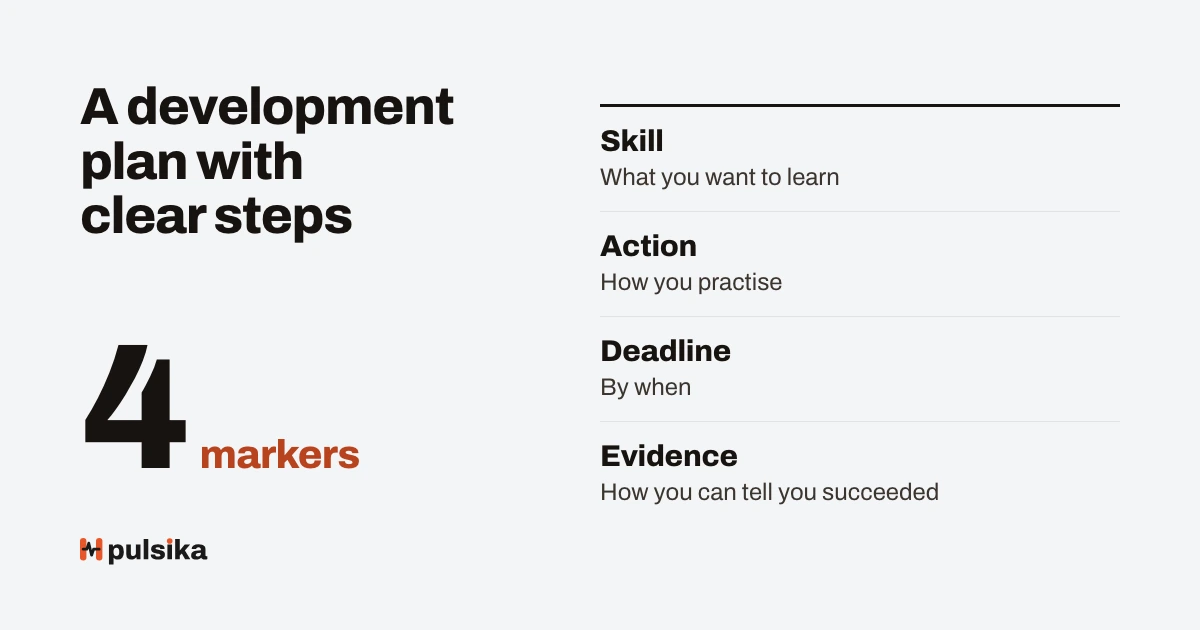
A good individual development plan (IDP) fits on one page: one or two development objectives linked to the current role or the next one, the concrete actions through which the person learns, the support the manager promises, the evidence by which you can tell they have learned, and the deadlines. The rest is decoration.
The guide gives you an IDP template field by field, two completed examples (one for an employee, one for a manager), an eight-question check you can apply to any plan and a calculation that shows how to use the 70-20-10 rule as a check on balance, not as a quota to meet.
Quick answer. The individual development plan is a short document, agreed between the employee and the manager, that sets out which skills the person will develop over the next 6–12 months, through which actions (new tasks, learning from colleagues, courses), with what support and by what evidence progress can be seen. It is reviewed quarterly and does not decide pay or sanctions.
What the individual development plan is
The individual development plan is a written agreement between an employee and their manager about what the employee will learn over a given period, and how. It starts from a real need: a gap against the requirements of the current role, preparation for a next role or a skill the team needs.
- The development objective describes a skill or a behaviour that changes (“runs the end-of-shift close alone”), not an activity (“takes a course”).
- The development action is what the person concretely does in order to learn: a new task, shadowing a colleague, a course, some reading, a project.
- The evidence is what the manager or someone else observes when the objective has been reached: a task done alone, correctly, a certain number of times.
- The 70-20-10 rule is a guideline from management development: roughly 70% of learning comes from work experience, 20% from relationships (feedback, mentoring, watching others) and 10% from formal courses.
IDP, training plan and improvement plan: what sets them apart
The three documents are often confused. The difference matters, because each has a different purpose, a different initiator and different consequences.
| Document | Purpose | Who initiates it | Basis and consequences |
|---|---|---|---|
| Individual development plan | A person’s growth in the current role or towards another | The employee and the manager, by mutual agreement | A management practice, not a legal obligation; it has no disciplinary consequences |
| Annual vocational training plan | The company’s training programmes for a year | The employer, after consulting the trade union or the employees’ representatives | Mandatory for an employer that is a legal entity with more than 20 employees (Romania’s Labour Code, art. 195) |
| Performance improvement plan | Correcting results below requirements, within a short time | The manager, after an evaluation | A management practice; it may precede other measures, so it is discussed with the lawyer |
IDPs can feed the training plan: courses requested by several people become programmes in the annual plan. The reverse does not work: a training plan does not say what each person learns on the job.
What the law says about vocational training
Romania’s Labour Code (Codul muncii) does not require an individual development plan. It does, however, require a few things an IDP has to take into account (Law no. 53/2003, checked on the Legislative Portal on 18 October 2026):
- The employee has the right of access to vocational training (art. 39(1)(g)).
- The employer ensures participation in training programmes for all employees at least once every 2 years if it has at least 21 employees, and at least once every 3 years if it has fewer than 21; the employer bears the costs (art. 194).
- The forms of training include courses, placements for adapting to the job’s requirements, on-the-job apprenticeship, individualised training and other agreed forms (art. 193).
- When the employer pays for the training, its duration and the parties’ rights and obligations are set out in an addendum to the individual employment contract (art. 196(2), art. 197–198).
Caution. If an IDP includes a course paid for by the company with an obligation on the person to stay for a period, that obligation is not written in the IDP but in an addendum, under art. 198 of Romania’s Labour Code. Check the wording with the company’s lawyer.
The IDP template, field by field
The template below fits on one page. Each field has a question it answers and an example of good wording.
| Field | Which question it answers | Example wording |
|---|---|---|
| Direction | Towards which role, or which level in the current role? | “Shift coordinator within 12 months” |
| Development objective (1–2) | What will the person do differently? | “Plans the weekend shift alone, with no gaps in cover” |
| Why now | Which need of the role or the team does it meet? | “The team has only one person who does the scheduling” |
| Actions | How, concretely, do they learn? | “Does the schedule for 4 weekends, checked by the manager” |
| Support | What does the manager or the company provide? | “One hour a week with the manager; access to the scheduling system” |
| Evidence | How do we see that they have learned? | “3 consecutive schedules accepted without corrections” |
| Deadlines and reviews | When do we check? | “A review every quarter; closed in October” |
To word the objectives, use the same criteria as for performance objectives; the guide on SMART objectives has examples by role. To choose the skill to develop, a skills matrix shows where the team depends on a single person.
A completed example for an employee
Hypothetical example. Fictitious data. Ioana is a sales consultant in a retail store of 9 people and wants to become a shift coordinator. The store manager agrees, and the store needs a second person who can run a shift.
| Objective | Action | Source of learning | Estimated hours (6 months) | Evidence |
|---|---|---|---|---|
| 1. Plans the weekend shift alone | Does the schedule for 4 weekends, checked by the manager | Experience | 16 | 3 consecutive schedules accepted without corrections |
| 1. Plans the weekend shift alone | Goes through each corrected schedule with the manager | Relationships | 4 | The list of frequent mistakes, written by Ioana |
| 2. Gives colleagues feedback at opening and closing | Runs the 10-minute opening briefing 10 times, with preparation | Experience | 20 | The manager observes 2 briefings and marks them on a 5-point checklist |
| 2. Gives colleagues feedback at opening and closing | Watches 4 briefings run by a coordinator from another store | Relationships | 8 | Short notes on what she takes on board |
| 2. Gives colleagues feedback at opening and closing | An internal course on feedback conversations | Formal course | 8 | The course test passed |
The estimated total is 56 hours over 6 months, about 2 hours a week. The calculation by source: experience 16 + 20 = 36 hours, that is 36 ÷ 56 = 64%; relationships 4 + 8 = 12 hours, that is 21%; course 8 hours, that is 14%. The rounded percentages add up to 99% because of rounding.
What the calculation tells you: the plan has actions from all three sources, and the weight lies on practice. It does not tell you that the plan is good. A plan with 64% experience can fail if nobody checks Ioana’s schedules.
An example for a manager
A manager’s IDP has two parts: their own development and their role in their people’s plans.
Hypothetical example. Fictitious data. Mihai runs the reception of a hotel with 12 employees. At the last evaluation, his people said that the small decisions all end up with him, and he often works overtime.
- Objective 1: delegates routine decisions. Actions: writes the list of decisions he takes in a week; chooses 5 that he hands over, with written rules, to two senior receptionists; discusses monthly with the hotel manager what worked. Evidence: in the following quarter, those 5 decisions no longer reach him, and complaints about them do not rise.
- Objective 2: holds development conversations with each person. Actions: one one-to-one meeting a month with each; an IDP agreed with each of the 12 by the end of the quarter. Evidence: 12 signed plans, reviewed once.
- Support requested: one session a month with a more experienced manager from the group, as a mentor.
The manager’s role in the team’s IDPs comes down to three things: they create opportunities for practice (tasks, rotations, standing in for others), give feedback on what they have seen and protect learning time when the shift gets busy.
The 70-20-10 rule: what it says and what it does not
The rule comes from the Center for Creative Leadership’s “Lessons of Experience” research on how managers learn. The proportions were formulated by Morgan McCall, Michael Lombardo and Robert Eichinger and published in 1996, based on what nearly 200 executives said about how they had learned (CCL, the Wikipedia summary).
The limits are documented. The data are retrospective statements by managers, not measurements of learning. A literature review published in 2018 in Human Resource Development Review (Clardy, cited in the same summary) concluded that the empirical basis for the “70% rule” is weak. CCL itself presents the figures as a guideline, not a recipe.
- Use it as a check: does the plan have practice, learning from others and structured content?
- Do not use it as a budget or hours norm (“only 10% courses”). For regulated knowledge, a course with a test may be the most important part.
- Do not assume that experience produces learning on its own. Without feedback and reflection, the person repeats the same mistakes faster.
How to build an IDP in six steps
- Separate preparation. The employee notes where they want to get to and what they lack; the manager notes what they see and what the team needs.
- The alignment conversation. In 45–60 minutes, agree the direction and at most two objectives. What does not fit waits for the next plan.
- The actions. For each objective, at least one practice action and one action of learning from someone. Add a course only if knowledge is missing, not practice.
- The evidence. Write down what you will observe at the end, with a number or a concrete example.
- Support and costs. Time, access, money. If there is a paid course with obligations, prepare the addendum separately.
- The calendar. A short check monthly, in the one-to-one conversation, and a quarterly review in which you update the plan.
Practical tip. Keep the IDP conversation separate from the conversation about pay or the bonus. When the two get mixed, people choose objectives that are easy to tick off, not the ones they need.
How to check the quality of an IDP: eight questions
Apply the list to any plan before you sign it. Each “no” shows what needs redoing.
- Does it have at most two development objectives?
- Does each objective describe a behaviour, not an activity?
- Is each objective linked to a need of the role or the team?
- Does each objective have at least one practice action on the job?
- Is someone named who gives feedback?
- Can an outsider check the evidence?
- Do the actions fit into the real schedule, with estimated hours?
- Is the first review scheduled, with a date?
Common mistakes
- A list of courses presented as a plan. Correct it: start from the behaviour, then choose the actions.
- Too many objectives. Five objectives usually means none followed through. Keep two.
- Vague evidence (“copes better”). Correct it: an observable task, a certain number of times.
- The plan filled in by HR, without a conversation. Without the person’s agreement, the plan stays a form.
- The forgotten review. An IDP not reviewed until the annual appraisal has not been used. Tie it to the monthly meetings.
- The IDP used as a sanction. For results below requirements there is the improvement plan, with other rules; see the evaluation conversation when results are poor.
Frequently asked questions
Is the individual development plan required by law?
No, Romania’s Labour Code does not require an individual plan for each employee. The law requires participation in training at least once every 2 years (from 21 employees) or every 3 years (below 21), under art. 194, and an annual training plan for employers that are legal entities with more than 20 employees, under art. 195. The IDP is a management practice.
How often is an IDP reviewed?
Review it briefly every month, in the one-to-one meeting, and in depth once a quarter. At the quarterly review, check the evidence, drop the actions that did not work and add others. A 12-month plan without any interim review usually ends up being filled in retrospectively, just before the annual appraisal.
Who writes the individual development plan?
The employee writes the first draft, and the manager discusses it and adds the support they can offer. HR provides the template, checks a sample of plans and gathers the common needs for the annual training plan. A plan written only by the manager or only by HR has little chance of being followed, because the person has not taken ownership of it.
How many objectives does an IDP have?
One or two development objectives are enough for 6–12 months. Each objective needs repeated practice, feedback and time, so more objectives share the same available hours. If the person has several needs, choose the one that matters most for the current role or the next one and postpone the others.
Do the 70-20-10 proportions have to be followed exactly?
No. The proportions come from managers’ retrospective statements and are not a measured norm. Use them as a check on balance: does the plan have practice, learning from others and structured content? For regulated or technical knowledge, the formal course may carry a much larger share, and that is right.
What do you do if the employee does not want to move up?
Build the plan on the current role: more autonomy, a new task, a second skill that is critical for the team or the role of trainer for new colleagues. Development does not mean only promotion. A good specialist who stays in the role and becomes the person others learn from reduces the team’s dependence on a single person.
Is the IDP linked to the bonus?
Better not directly. When the bonus depends on ticking off the actions in the IDP, people choose objectives that are easy to reach. Results in the role are evaluated separately, with the indicators and the evaluation form; the IDP follows learning. The natural link is a different one: the skills acquired improve, over time, the results measured in the evaluation.
What to do next
Choose a single team and draw up IDPs with the template above, then apply the eight-question check before signing. To choose the skills, use the skills matrix, and to check whether a course in the plan changed anything on the job, read the guide on checking the effectiveness of training. If the IDP starts from an evaluation, the guide on performance and potential shows how to keep the two conversations apart.