

 Română
 English
 Deutsch
 Magyar
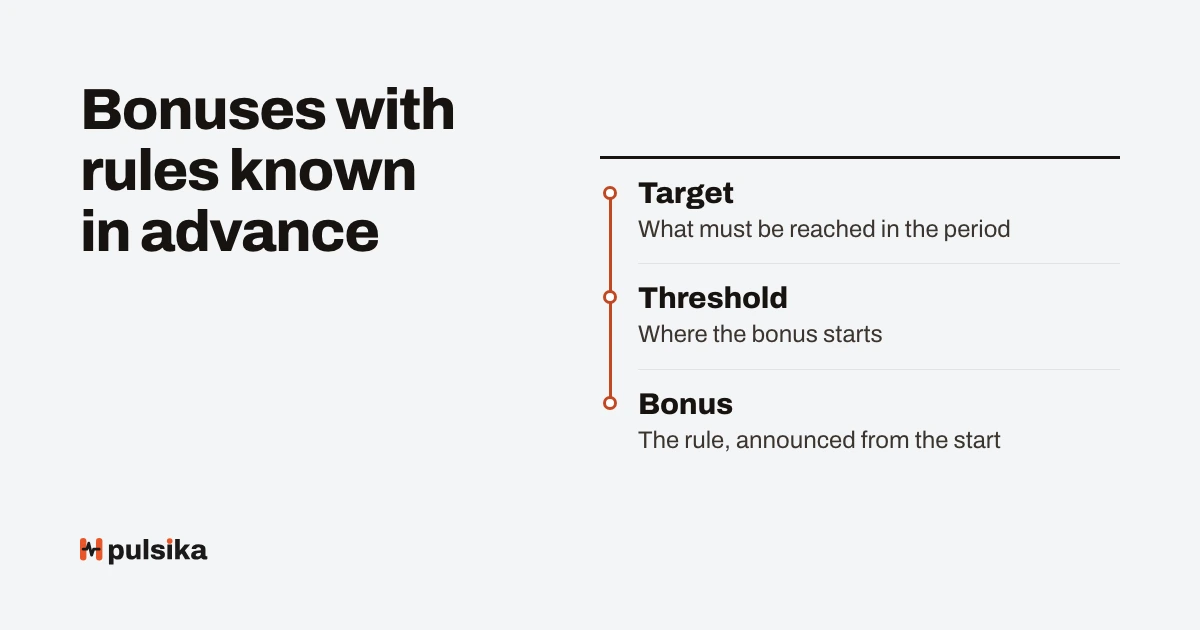
A well-built performance bonus has five elements written down in advance: the target bonus paid at 100% achievement, the entry threshold below which nothing is paid, the curve between the threshold and the target, the accelerator above target and the cap. Where it matters, add to these a quality gate that stops or reduces the bonus when the volume was achieved badly.
The article shows a worked example for five people, compares a stepped scheme with a linear one, explains the documented risks of accelerators and how to check the cost on past data, plus what Romania’s Labour Code says about pay and changing it.
Quick answer. Set a target bonus for 100% achievement, an entry threshold (for example 85%), a linear increase up to the target, a moderate accelerator above target and a cap. Add a quality gate for indicators that can be inflated. Test the scheme on past months, calculate the cost and write the rules into the company’s documents, checked by the company’s lawyer.
The terms of a bonus scheme
- The target bonus is the amount paid when achievement is exactly 100% of target. The rest of the scheme is expressed relative to it.
- The entry threshold is the minimum achievement from which anything is paid. Below the threshold, the bonus is zero.
- The payout curve describes how the bonus rises between the threshold and the cap: in steps or continuously.
- The accelerator is a higher payout rate above target: each percentage point above 100% brings more than one below 100%.
- The cap limits the maximum bonus, usually through a maximum achievement taken into account (for example 120%).
- The quality gate is a condition that must be met for the bonus to be paid in full: an audit, a maximum returns rate, a minimum result for the unit.
- The measurement period is the interval over which achievement is calculated: month, quarter, year.
Three curve shapes
| Shape | How it pays | Advantage | Main risk |
|---|---|---|---|
| Stepped | A fixed amount for each band of achievement (for example 85–94.99%, 95–99.99%, from 100%) | Easy to explain and to calculate | Large jumps at the edge of a step: a sale moved from one month to another changes the bonus a lot |
| Linear with a threshold | Zero below the threshold, then an amount that rises proportionally up to the target | Every extra point counts the same | A single jump, at the threshold |
| Linear with an accelerator and a cap | As above, with a higher rate above target, up to the cap | Rewards beating the target without unlimited cost | Encourages moving sales into the period in which the accelerator pays |
Worked example: five sales consultants
Hypothetical example. Fictitious data. The monthly target bonus is 1,000 lei for 100% of the sales plan. Below 85%: 0 lei. From 85% to 100%: from 500 to 1,000 lei, linearly (33.33 lei per percentage point). Above 100%: 50 lei for each point (an accelerator of 1.5 times), up to the cap of 120% achievement, that is at most 2,000 lei. The quality gate: if the monthly service audit is below 80 points, the calculated bonus is halved.
| Consultant | Achievement | Audit | Bonus calculation | After the gate |
|---|---|---|---|---|
| Andrei | 82% | 90 | Below the threshold: 0 | 0 lei |
| Bianca | 92% | 85 | 500 + (92 − 85) × 33.33 = 733.33 | 733.33 lei |
| Corina | 100% | 78 | 1,000 | 500 lei (audit below 80) |
| Daniel | 108% | 88 | 1,000 + (108 − 100) × 50 = 1,400 | 1,400 lei |
| Emil | 131% | 91 | Cap 120%: 1,000 + 20 × 50 = 2,000 | 2,000 lei |
| Total | 4,633.33 lei |
The total cost is 4,633.33 lei, that is 92.7% of the sum of the target bonuses (5 × 1,000 = 5,000 lei). The threshold leaves Andrei without a bonus, the gate reduces Corina’s, and the cap stops Emil at 2,000 lei instead of 2,550 lei (what 131% would have given).
The same month, with a stepped scheme
Suppose these steps: 500 lei for 85–94.99%, 750 lei for 95–99.99%, 1,000 lei from 100%. A consultant at 99.9% gets 750 lei, and one at 100% gets 1,000 lei: 250 lei for a tenth of a percentage point. In the linear scheme above, the difference between 99.9% and 100% is 3.33 lei.
Large jumps create a strong reason to move a sale from one month to another or to rush a price discount. A study of sales data from manufacturing found that sales were higher at the end of the fiscal year and lower at the start, a pattern consistent with the non-linear pay contracts of salespeople and managers.
Remember. The larger the jumps in a scheme, the stronger the reasons people have to move results between periods. The linear curve keeps a single jump, at the threshold. If even that is not acceptable, start the curve from zero at the threshold.
How to choose the entry threshold
The threshold answers the question “below what level do we pay nothing?”. A threshold that is too low pays for poor results; one that is too high leaves many people with nothing at stake after the first bad weeks of the month.
- Start from history. Over the last 6–12 months, see what percentage of people would have been below the threshold each month. If a third are consistently below it, either the targets or the threshold need to be reviewed.
- Take the targets into account. A threshold of 85% means something different for an easy target than for an ambitious one.
- Use longer periods for activities with irregular results: a month without a large sale should not cancel out a good quarter.
Accelerators: when they help and what they risk
The accelerator rewards beating the target. A study of one company’s sales force found that commissions for exceeding the target kept the best salespeople productive even after they had reached the target, while quarterly bonuses helped the weakest keep pace towards the annual target. The result comes from a single company, so it is not a universal rule.
The risk is playing with timing. At a large software vendor, a commission scheme with an accelerator led salespeople to shift when they closed contracts and to accept lower prices in the quarters in which the scheme paid more, at a cost the author estimated at 6–8% of revenue.
- Keep the accelerator moderate (for example 1.25–1.5 times the rate below target), not 3–4 times.
- Put a gate on the price or margin of the sale where the salesperson controls the discount.
- Calculate the accelerator over longer periods (quarter, year) if people can move sales between months.
Caps: why and how high
The cap protects the budget from three situations: a wrong target, an unexpected gain that has nothing to do with the person (a large customer who came from elsewhere, a price change) and a data error. Without a cap, a single exceptional month can cost as much as a quarter’s bonuses.
The cap has a cost too: once the person has reached it, they have no reason to sell any more in that period and may hold sales back for the next one. To reduce the effect, set the cap high enough that it is rarely reached and check on history how many people would have reached it. If more than a few reach it every month, the targets are probably too low.
Quality gates
| Type of gate | Example | What it protects | Usual effect |
|---|---|---|---|
| Individual quality | The service audit, returns, justified complaints | Volume achieved through poor service or pushed sales | Bonus reduced or no accelerator |
| The unit’s result | The unit reaches at least 90% of plan | Collaboration; avoids large bonuses in a loss-making unit | Bonus reduced proportionally or cancelled |
| Compliance | Mandatory training completed, stock count with no shortfalls | The rules that are not traded for volume | Bonus cancelled or suspended until put right |
| Margin or price | The average discount given stays below a threshold | Sales bought with discounts | Accelerator cancelled |
A gate must depend on things the person can influence and must have reliable data. A gate based on an audit that is not carried out every month turns a missing audit into a lost bonus; write down in advance what happens when the gate’s data is missing.
What the scheme costs: checking it on past data
Calculate the scheme over the last 6–12 months, for everyone, as if it had been in force. For each month, note the total cost, the cost as a percentage of the target bonuses, how many people were below the threshold, how many at the cap and how many were stopped by the gate. The method is the one in the article on testing a KPI scorecard, and the file weights-and-scores-simulation.xlsx helps you see how the scores are spread before you tie money to them.
If, in the example above, the typical month cost 92.7% of the target bonuses, the annual budget is planned around that value, with a reserve for good months. A cost that consistently exceeds 100% points to targets that are too low or an accelerator that is too generous.
What Romania’s Labour Code says about pay and bonuses
The rules below are legal obligations; the rest of the article contains management recommendations. The text is that of Romania’s Labour Code (Codul muncii), in the consolidated version of 27 April 2026.
- What pay is made of. Pay comprises the base salary, allowances, premiums and other additions (art. 160(1)).
- Information. The employee is informed of the base salary and the other components of their earnings, shown separately (art. 17(3)(k)).
- Changes. The individual employment contract, including pay, is changed only by agreement of the parties; a unilateral change is possible only in the cases and under the conditions set out in the code (art. 41(1), (2) and (3)(e)).
- Non-discrimination. Any discrimination in setting and granting pay is prohibited (art. 159(3)).
- Confidentiality. Pay is confidential (art. 163(1)). A public ranking of bonuses needs a separate analysis.
- Evaluation criteria. The employer sets the performance objectives and the evaluation criteria (art. 40(1)(f)), and the internal regulations contain the criteria and procedures for professional evaluation (art. 242(i)).
Directive (EU) 2023/970 on pay transparency also includes in pay the complementary or variable components (art. 3) and requires workers to have access to the criteria used to determine pay, criteria that are objective and gender-neutral (art. 6). The transposition deadline was 7 June 2026.
Caution. Where the scheme is written down (individual contract, addendum, internal regulations, collective agreement or a separate policy) changes what you can modify unilaterally and how. Check with the company’s lawyer the form of the documents, how the scheme is communicated and the status of the Romanian law transposing the directive, before the first month in which the scheme applies.
The steps in building a scheme
- Set the budget and the target bonus as an amount or a percentage of the base salary, by role.
- Choose the indicator or the score on which the bonus is calculated and the measurement period.
- Fix the threshold, the curve, the accelerator and the cap, in that order.
- Add 1–2 quality gates, with the rule for missing data.
- Calculate the scheme over 6–12 past months: monthly cost, how many below the threshold, how many at the cap, how many stopped by the gate.
- Adjust and recalculate, one choice at a time.
- Write down the rules with a full worked example and check the documents with the lawyer.
- Communicate the scheme before the period in which it applies and review it after the first three periods.
Common mistakes
- Steps with large jumps. Fix: a linear curve between the threshold and the target.
- An accelerator without a cap. A wrong target becomes an unlimited cost. Fix: a cap on the achievement taken into account.
- A gate without reliable data. Fix: gates only on indicators measured regularly, with a rule for missing data.
- The scheme changed after the results were seen. Fix: changes apply from the next period, communicated in advance.
- A bonus on an indicator the person does not control. Fix: team indicators with a small weight or as a gate.
- Cost not calculated on history. Fix: a simulation over 6–12 months before launch.
- A bonus tied to ambitious objectives. Fix: the bonus on realistic targets; the difference is explained in KPI vs. OKR.
Bonuses in Pulsika
In Pulsika, the bonus is set at the “Levels and bonuses” step of the scorecard. A bonus rule gives a fixed amount, in the chosen currency, for a level (for example “Excellent”) or for a score band (“From” … “Up to”, upper limit excluded) — in other words a stepped scheme.
- Continuous curves and gates. The “Bonus from a formula” field replaces the simple rules. The formula can use the scorecard’s parts, the total and any indicator, for example a bonus that is cancelled below a threshold for the unit.
- The cost. The simulation on the scorecard page also shows, for a closed period, the total of the bonuses, without saving anything.
- Who sees it. Each employee sees their bonus next to their score in “My scores”; the manager sees it for the people in their reach.
Pulsika calculates and shows the amount; the payment rules remain those in the company’s documents. Building your own scorecards and formulas is included in the Professional and Enterprise plans.
Frequently asked questions
What is a bonus accelerator?
The accelerator is a higher payout rate above target: each percentage point above 100% brings more than a point below 100%. In the article’s example, a point below target is worth 33.33 lei, and one above target 50 lei. The accelerator rewards beating the target, but it increases the incentive to move sales between periods.
What entry threshold is right?
There is no universal threshold: in the article’s example the threshold is 85%, but the right value depends on how ambitious the targets are and how much results vary from one month to the next. Calculate on history how many people would have been below the threshold each month. If a third stay consistently below it, review the targets or the threshold before launch.
Does a performance bonus have to have a cap?
The cap is not a legal obligation, but a recommended protection for the budget. It limits the cost of a wrong target, an unexpected gain or a data error. Its price is that, once it is reached, the person has no reason to sell any more in that period. Set it high enough that it is rarely reached.
What is a quality gate?
The quality gate is a condition that must be met for the bonus to be paid in full, for example a service audit of at least 80 points or returns below a certain percentage. It prevents volume being achieved through poor service or pushed sales. The gate needs reliable data and a written rule for when the data is missing.
Can I change the bonus scheme halfway through the year?
The change applies from the next period, communicated in advance, never retroactively. If the scheme is part of the individual employment contract, the change requires the agreement of the parties (art. 41 of Romania’s Labour Code). If it is in the internal regulations or in a separate policy, the procedure differs. Check with the company’s lawyer before the change.
Is a monthly or a quarterly bonus better?
A monthly bonus gives quick feedback and suits activities with regular results, such as daily sales in a shop. A quarterly or annual bonus reduces playing with the timing of sales and suits irregular results. A mixed option combines small monthly payments with a quarterly true-up. The choice is tested on past data.
Is the bonus calculated on a single indicator or on a score?
A single indicator is easy to understand, but it encourages optimising that indicator alone. A score made of several weighted indicators balances volume with quality, but it is harder to explain. An intermediate option is the bonus on the main indicator, with the other indicators as gates. Whatever you choose, communicate it with a full worked example.
What to do next
Take the current bonus scheme (or a proposal), recalculate it over the last six months with the table above and note the cost, how many people are below the threshold and how many at the cap. For indicators that can be inflated, read KPIs that encourage the wrong behaviour; for choosing the indicators, the guide on how to choose KPIs. To see scorecards with levels and bonuses on fictitious data, enter the demo company.