

 Română
 English
 Deutsch
 Magyar
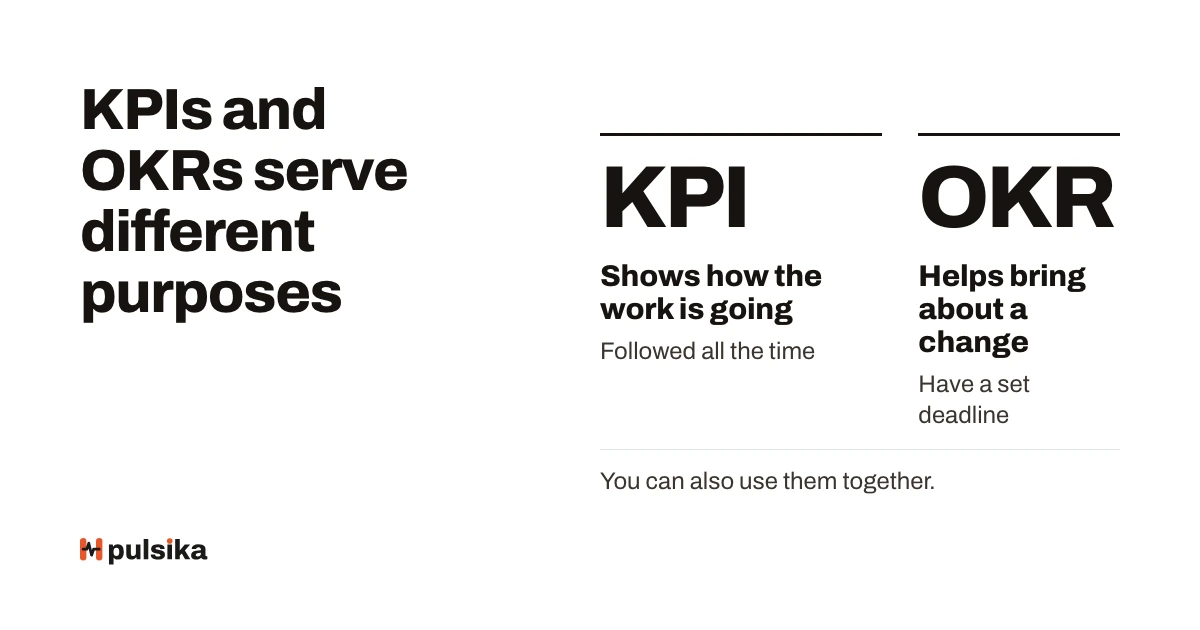
KPIs and OKRs answer different questions. A KPI shows whether an activity that is already running stays healthy: sales, service times, errors, with realistic targets followed month by month. An OKR shows whether you achieve a change within a quarter: an ambitious objective and 2–4 measurable key results, of which reaching 60–70% is considered good. The two combine: KPIs for day-to-day running, OKRs for what you want to change.
The article compares the two on eight criteria, shows when each one fits, gives a worked example of scoring an OKR alongside the same team’s KPIs and explains why ambitious OKRs are not tied directly to the bonus.
Quick answer. KPIs continuously measure the performance of existing activities, with targets you expect to be met. OKRs set, for a quarter, an objective of change and measurable key results, often ambitious ones. Use KPIs for day-to-day running and OKRs for 1–3 priorities for change, while the KPIs remain the limits that the change is not allowed to break.
What KPIs and OKRs are
A key performance indicator (KPI) is a measure with a definition and a source, followed regularly against a target, that shows how well an activity is working. “Payments collected on time, as a percentage of invoices due” is a KPI. The difference between an objective, a KPI, a target and a task is explained in the article on KPIs, objectives and tasks.
OKR (Objectives and Key Results) consists of an objective stated in words, qualitative and ambitious, and a few (usually 2–4) measurable key results that show whether the objective has been achieved. Google’s re:Work guide recommends three to five objectives, with about three key results each, and key results describe effects, not activities.
The method comes from Peter Drucker’s management by objectives. Andy Grove adapted it at Intel, and John Doerr presented it to Google’s founders in 1999. According to Doerr’s website, Grove made OKRs quarterly and separate from pay, unlike traditional annual objectives.
Committed OKRs and ambitious OKRs
Google’s internal guide published by Doerr distinguishes two kinds. Committed OKRs (committed) must be achieved in full: a service that meets its service level in the quarter, a feature delivered on time. Ambitious OKRs (aspirational) describe how things should look, even if the team does not yet know exactly how it will get there; the expected score averages 0.7. The guide says that failing to tell the two apart is the first trap.
The differences, criterion by criterion
| Criterion | KPI | OKR |
|---|---|---|
| The question it answers | “Are we working as we should?” | “Have we achieved the change we set out to make?” |
| Horizon | Continuous; monthly, weekly or daily | Usually a quarter, then new ones are set |
| The target | Realistic; meeting it is the norm | Ambitious, in the case of ambitious OKRs; reaching 60–70% is considered good |
| How long it lasts | Years, as long as the activity exists | Until it is achieved or until the priority changes |
| How many | 3–5 per role | Google recommends 3–5 objectives, each with about 3 key results; at the start, 1–3 per team are easier to follow |
| Scoring | Value against target, often normalised and weighted into a score | Each key result from 0 to 1, the objective from the approximate average |
| The link with money | Can be used in bonuses and evaluations, with realistic targets | Separate from evaluation and pay, in the original version |
| Visibility | Usually for the person, the manager and HR | Public within the organisation, so that everyone can see who is working on what |
The 60–70% threshold comes from Google’s practice: the re:Work guide says that OKRs are scored from 0.0 to 1.0, and the “sweet spot” is between 60% and 70%. Whoever consistently reaches 100% has not set objectives that are ambitious enough.
When each one fits
| Situation | Fits | Why |
|---|---|---|
| A shop that runs steadily and must keep up its sales and its quality of service | KPI | The aim is not a change, but keeping a level |
| Launching a new service (home delivery, online bookings) | OKR | The result is uncertain, and what is learned during the quarter matters |
| A chronic problem (long waiting times, many returns) | OKR to fix it, then KPI to keep it fixed | The change needs focus; the result achieved must then be guarded |
| The monthly bonus of sales teams | KPI | Money calls for realistic targets and stable rules |
| Coordinating several departments on a priority for the year | OKR | Public objectives show who contributes to what |
| Support functions with a steady volume (payroll, accounting) | KPI, possibly an improvement OKR | The work is repetitive, but the process can be improved |
How to combine them
KPIs and OKRs do not compete. Four ways of linking them, often used together:
- KPIs as limits. An OKR is not allowed to break a KPI. If the OKR asks for faster check-in, the KPI “billing errors” is still followed, with its limit.
- The key result moves a KPI. A good key result is often an improvement to an existing KPI: “the average waiting time falls from 12 to 5 minutes”.
- A falling KPI triggers an OKR. When a KPI stays below target for a few months, the problem becomes a priority for the following quarter.
- Different rhythms. KPIs are discussed monthly in the regular evaluation; OKRs are set at the start of the quarter, checked halfway through and scored at the end.
Remember. A KPI says whether the activity stays healthy. An OKR says whether the intended change has succeeded. When an OKR achieves its aim, its result often becomes a KPI’s target.
Worked example: KPIs and OKRs in the same team
Hypothetical example. Fictitious data. The front desk of a chain of four hotels follows KPIs monthly and sets itself an OKR for the fourth quarter: “Arriving at the hotel becomes quick and worry-free”.
Each key result is scored here by a linear convention: progress from the starting value to the target, between 0 and 1. The re:Work guide describes a similar scoring (“six features planned, three launched” gives 0.5), but each company chooses its own convention.
| Key result | Start | Target | Achieved | Calculation | Score |
|---|---|---|---|---|---|
| Average waiting time at check-in | 12 minutes | 5 minutes | 7 minutes | (12 − 7) ÷ (12 − 5) = 5 ÷ 7 | 0.71 |
| Hotels with working online check-in | 0 | 4 | 3 | 3 ÷ 4 | 0.75 |
| Guests’ rating of arrival (out of 10) | 8.1 | 8.8 | 8.4 | (8.4 − 8.1) ÷ (8.8 − 8.1) = 0.3 ÷ 0.7 | 0.43 |
The objective’s score is the average of the three: (0.714 + 0.750 + 0.429) ÷ 3 = 0.63. For an ambitious OKR, the result lies in the 0.6–0.7 zone: the team has made a lot of progress, without the target having been too easy.
| Front desk KPI (limit) | Target | Quarter average | Conclusion |
|---|---|---|---|
| Invoices corrected after the guest has left | at most 1% | 0.8% | Speed has not harmed accuracy |
| Justified complaints about the front desk per 1,000 arrivals | at most 3 | 2.6 | Within the limit |
Without the limit KPIs, a shorter check-in time could have hidden more billing errors. Without the OKR, the front desk would have gone on reporting the same 12 minutes month after month, with no plan to reduce them.
Why ambitious OKRs are not tied directly to the bonus
The re:Work guide says explicitly that OKRs are not synonymous with performance evaluation: they summarise what someone worked on and what effect it had, they do not fully evaluate a person. The reason is practical: if 0.6 is a good result but the bonus is paid at 1.0, people will propose objectives they know they will reach. The OKR loses its point, and the bonus pays for an easy target.
- For the bonus, use KPIs with realistic targets and stable rules; the details of how to build one are in the article on thresholds, accelerators and caps in bonuses.
- OKRs can go into the evaluation as information about contribution, discussed, not as a calculation formula.
- Committed OKRs, with targets you expect to be met, can be treated as KPIs: there, meeting them in full is the norm.
How to introduce OKRs alongside existing KPIs
- Keep the KPIs. They remain the current measurement system; OKRs are added, they do not replace them.
- Choose 1–3 priorities for change for the quarter, at company or department level. More dilutes the effort.
- Write the objective in words, as a clear end state: “Arriving at the hotel becomes quick and worry-free”.
- Formulate 2–4 key results with a starting value, a target and a source. If a key result contains “we analyse”, “we take part”, “we help”, it describes an activity, not a result.
- Name the limit KPIs that the OKR is not allowed to break.
- Set the scoring convention (linear, from start to target, or achieved / not achieved) before the quarter.
- Check halfway through the quarter and adjust the action plan, not the target.
- Score at the end and discuss what you have learned, then decide what becomes a permanent KPI.
Common mistakes
- KPIs renamed as OKRs. “We maintain sales” is not an objective of change. Fix: an OKR describes a new state, not a continuation of the current one.
- Key results that are tasks. “We hold three meetings” gets ticked off without anything changing. Fix: measure the effect of the meetings.
- Too many OKRs. Ten objectives a quarter means no objective. Fix: 1–3 per team, at the start.
- A bonus on ambitious OKRs. Fix: the bonus on KPIs, OKRs as information in the evaluation.
- An OKR without limits. Speed goes up, quality goes down. Fix: name the limit KPIs in advance.
- The target changed halfway, so that the score works out. Fix: change the action plan; the target stays, and the lesson is noted at the end.
Frequently asked questions
What is the main difference between KPIs and OKRs?
The main difference is the purpose. A KPI continuously measures how well an existing activity is working, with targets you expect to meet. An OKR sets, for a short period, usually a quarter, a desired change and the measurable results that confirm it. The KPI guards the normal; the OKR moves it.
Can I use OKRs without KPIs?
You can, but it is risky: OKRs cover only a few priorities, and the rest of the activity stays unmeasured. A team focused on a speed OKR can lose quality without noticing. KPIs cover day-to-day running and signal when a change breaks something else. In most companies, OKRs are added on top of a small set of KPIs.
Can a key result be a KPI?
Yes, and this is often the best key result: a measurable improvement to an existing KPI, with a starting value and a target. For example, “the average waiting time falls from 12 to 5 minutes”. The difference lies in the ambition and the period: the key result asks for a change within the quarter, the KPI follows the usual level.
How is an OKR scored?
Each key result gets a score from 0 to 1, and the objective gets the approximate average of the key results. The usual convention is linear, from the starting value to the target. At Google, the zone considered good for ambitious OKRs is 0.6–0.7. The convention is set before the quarter, not after you see the results.
Do OKRs suit small companies?
Yes, if there is a clear change to pursue and someone who keeps up the quarterly rhythm. A company of 30 people can have a single company-level OKR per quarter, with 2–3 key results, alongside the usual KPIs. Without a priority for change, OKRs become bureaucracy, and KPIs are enough.
Why is a bonus tied to OKRs not recommended?
Because ambitious OKRs are designed not to be reached in full: 0.6–0.7 is a good result. If the bonus requires 1.0, people propose easy targets and the method loses its purpose. Google’s re:Work guide says that OKRs are not synonymous with performance evaluation. KPIs with realistic targets are better suited to the bonus.
How often are OKRs and KPIs reviewed?
KPIs are followed as often as the data arrives (daily, weekly or monthly) and reviewed as a set once or twice a year. OKRs are set at the start of the quarter, checked at least once halfway through and scored at the end. At the review, a successful OKR often becomes the target of a KPI.
What to do next
List the KPIs you already follow and choose a single problem that deserves an OKR next quarter, with its limit KPIs. For the indicators that prepare the result, read the article on activity and result indicators, and for building objectives, SMART objectives with examples. When you choose the KPIs for a role, use the guide on how to choose KPIs.