

 Română
 English
 Deutsch
 Magyar
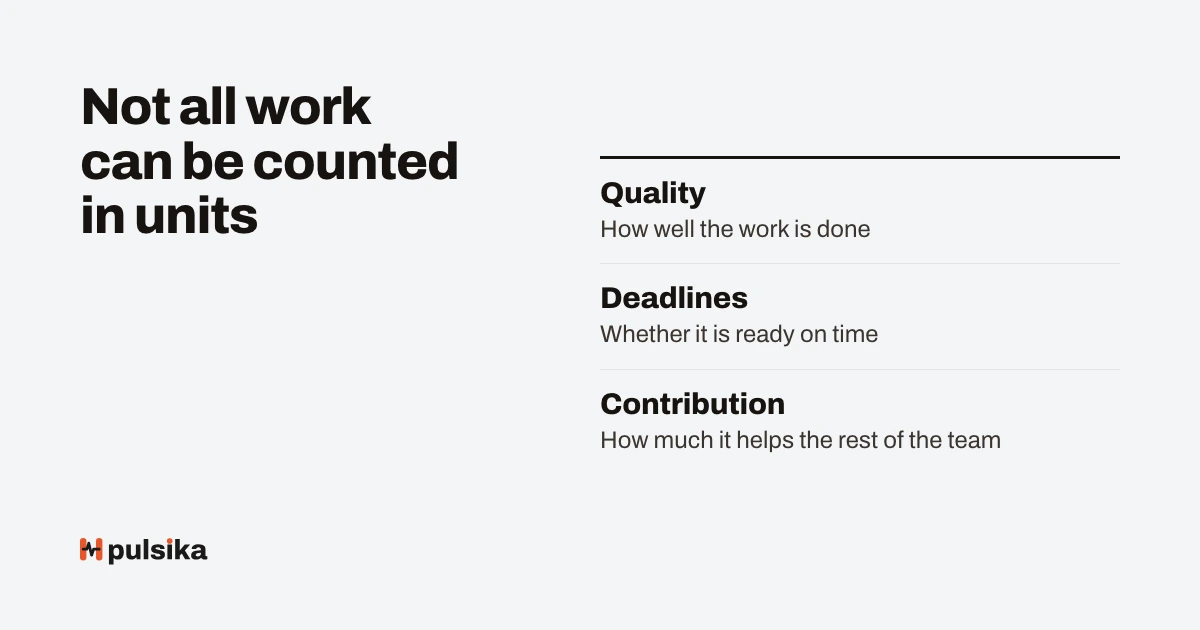
The performance of support, creative or back-office roles is measured through three layers put together: observable results (what the role delivers, not what activities it carries out), service indicators (how quickly and how well it serves its internal customers) and behavioural rubrics with concrete examples for each level. No layer is enough on its own. The article shows how to turn activities into verifiable results, how to build a rubric that two evaluators apply the same way, and calculates a full score for a payroll specialist.
Quick answer. For a role that is hard to measure, do not look for a single figure. Describe 2–3 verifiable results (a monthly close on time, materials approved without rework), add a service indicator for internal customers (requests resolved within the agreed time) and evaluate behaviours with a rubric anchored in examples. Ask the evaluator to explain what they observed, not just the mark.
Definitions: observable result, service indicator, rubric
A role that is hard to measure is one whose result appears late, depends on several people or is primarily qualitative. Accounting, payroll, in-house legal, IT support, design, internal communication and administrative assistance usually fall into this group.
An observable result is a finished product or service that someone else can check: “the payroll submitted on time”, not “handles payroll”. The performance management handbook of the Office of Personnel Management (OPM, 2017), the US federal government’s personnel agency, recommends that performance elements be “quantifiable or verifiable” and described as accomplishments (nouns), not as activities (verbs).
A service indicator measures how the role serves its customers, internal or external: response time, resolution on time, reopened requests, the satisfaction of the person served. It rests on a service level agreement (SLA), that is, a written promise about time and quality.
A behavioural rubric is a list of dimensions, each with concrete descriptions for each level. The rigorous version, the behaviourally anchored rating scale (BARS), was proposed by Patricia Cain Smith and L. M. Kendall in the Journal of Applied Psychology (1963): the anchors are real behaviours, checked by several experts.
Why some roles seem impossible to measure
Four situations make measurement difficult. Each calls for a different layer.
- The result appears late. A well-negotiated contract shows in the disputes that do not arise two years later. Use verifiable intermediate results (contracts reviewed on time, standard clauses respected) and the rubric.
- The result is collective. A successful campaign has five authors. Measure the part that belongs to the person: their deliverables, on time and approved.
- The result is qualitative. A “good” design has no unit of measurement. Define who judges and by what criteria, as OPM recommends for descriptive measures.
- The volume does not depend on the person. The number of tickets depends on how many problems arise, not on the operator’s effort. Measure the time and quality of resolution, not the number.
Remember. OPM uses four general measures for individual work: quality, quantity, timeliness and cost-effectiveness. For roles that are hard to measure, quantity is often the least relevant of them. Timeliness and quality almost always remain measurable.
Layer 1: from activities to verifiable results
The job description lists activities. The evaluation needs results. The translation is done with the question: “What exists at the end of the month that would not exist without this person?”
| Activity (from the job description) | Verifiable result | How it is checked |
|---|---|---|
| Handles payroll | The payroll and the returns submitted on time, with no later corrections | The submission date; the corrections in the following month |
| Produces graphic materials | Materials approved in at most two rounds of changes | The approval history |
| Provides IT support | Requests resolved within the agreed time, not reopened | The ticketing system |
| Reviews contracts | Contracts cleared within the internal deadline, with the checklist complete | The clearance register, spot checks |
| Organises training | Sessions held according to plan, with the invited participants present | The plan and the attendance records |
| Keeps the administrative records | Files complete at the quarterly internal check | The result of the sample check |
A good result has three properties: someone other than the person recognises it, it has a deadline and it has a quality criterion. If the quality criterion is missing, the result becomes a counted activity again.
Layer 2: service indicators for internal customers
Support roles have customers: colleagues in sales, in the shops, the managers. Service indicators measure what these customers receive.
- Resolution on time: the percentage of requests closed within the agreed time for each type of request (for example, a certificate within 2 working days).
- Reopened requests: the percentage of closed requests that come back because they were not resolved.
- Internal customer satisfaction: a single question after the request is closed (“Was the problem solved?”), not a long questionnaire.
- Errors that reached the customer: mistakes discovered after delivery, for example in the payroll or on an invoice.
The deadlines are set together with the internal customers, in writing, before measuring. A deadline imposed by the support team alone says nothing about the needs of the people served. A deadline demanded without resources turns the indicator into a source of frustration.
Practical tip. Ask three internal customers what they would notice if the role were done excellently and what if it were done badly. Their answers are usually the first service indicators and the first anchors for the rubric.
Layer 3: behavioural rubrics with anchors
A rubric with “poor, average, good” measures the evaluator’s impression. A rubric with anchors describes what the person concretely does at each level, so that two evaluators arrive at the same mark.
An example rubric: “Handling urgent requests” (IT support)
| Level | Description | Observable example |
|---|---|---|
| 1 — Below expectations | Handles requests in order of arrival, regardless of impact | A shop’s cash register stays blocked while a password change request is being dealt with |
| 3 — Meets expectations | Prioritises by impact and tells the requester the expected time | Fixes the cash register first and writes to the person who asked about the password when they get to it |
| 5 — Exceeds expectations | Prioritises, informs and prevents a repeat | Fixes the blockage, finds the cause and proposes a solution for all the shops with the same configuration |
Levels 2 and 4 stay intermediate, with no separate description. Three well-written anchors are more useful than five vague ones. A rubric has 3–5 dimensions; more dilute the evaluator’s attention.
How a rubric is built
The BARS method first gathers critical incidents (effective and ineffective behaviours observed), groups them into dimensions, asks experts to reassign them to the dimensions and keeps only the examples they agree on. The full process takes time, and the Wikipedia summary notes that even anchored scales do not entirely remove leniency or inconsistent marks between evaluators. A simplified version, with two or three evaluators and real examples, is realistic for a small company.
Examples by type of role
The table suggests starting combinations. The weights and deadlines are set within each company.
| Role | Observable results | Service indicators | Rubric dimensions |
|---|---|---|---|
| Payroll specialist | Monthly close on time | Later corrections, certificates issued on time | Rigour, communicating legislative changes |
| Accountant | Reports on time, reconciled accounts | Replies to other departments on time | Flagging risks, documentation |
| IT support | Infrastructure projects delivered | Resolution on time, reopened requests | Prioritisation, explaining the solution |
| Designer / content | Materials approved in at most two rounds | Delivery time against the request | Understanding the brief, consistency with the visual identity |
| In-house lawyer | Contracts cleared within the internal deadline | Response time to questions | Clarity of opinions, anticipating risks |
| Administrative assistant | Files complete at the check | Requests resolved on time | Organisation, discretion |
A full example: a payroll specialist
Hypothetical example. Fictitious data. The scorecard has three parts: Closing payroll on time (35%, “met or not met”: 100 or 0), Later corrections (30%, points in steps: 0 corrections = 100, 1 = 80, 2 = 50, 3 or more = 0) and the Behaviour rubric (35%, four dimensions marked 1–5, the total divided by the maximum of 20 and multiplied by 100).
In October, payroll closed on time (100). There was one correction in the following month (80). On the rubric, the manager gave 4, 3, 5 and 4, that is 16 out of 20, so 16 ÷ 20 × 100 = 80. The score is 0.35 × 100 + 0.30 × 80 + 0.35 × 80 = 35 + 24 + 28 = 87.
Every number can be explained: the closing date, the correction in the register, the example the manager noted for each dimension. The scorecard cannot exceed 100, so the level thresholds are chosen below this maximum, for example: from 70 “Partial”, from 85 “Meets expectations”, 100 “Exceeds expectations”. With these thresholds, 87 reads as “Meets expectations”. On a sales scorecard, where achievement can go above 100%, the thresholds will be different.
How to build the evaluation of a role that is hard to measure
- List the role’s customers, internal and external, and ask three of them what they would notice in excellent work and in poor work.
- Turn the activities in the job description into 2–3 verifiable results, each with a deadline and a quality criterion.
- Choose 1–2 service indicators and set the deadlines in writing, together with the internal customers.
- Write a rubric of 3–5 dimensions with anchors at levels 1, 3 and 5, starting from real examples.
- Test the rubric with two evaluators on the same three people; where they differ by more than one point, rewrite the anchor.
- Ask for a short justification for each mark (“what did you observe?”), not just the figure.
- Review after three months which results could not be checked and which anchors were unclear.
Caution. Romania’s Labour Code (Codul muncii, Law no. 53/2003) provides that the employer sets the individual performance objectives and the criteria for evaluating their achievement (art. 40(1)(f)), that the person is informed before hiring about the criteria for evaluating their professional activity (art. 17(3)(e)) and that the internal regulations contain the evaluation criteria and procedures (art. 242(i)). A new rubric used in evaluation must therefore be communicated; check with the company’s lawyer where and how.
Common mistakes
- Measuring hours or activity. Hours worked, emails sent, tickets taken show effort, not results. Correct it: verifiable results with a deadline and quality.
- Volume as the main indicator in support. The number of requests depends on how many problems arise. Correct it: resolution on time and reopened requests.
- A rubric without anchors. “Communication: 4” says nothing. Correct it: concrete descriptions at levels 1, 3 and 5.
- A single evaluator with no justification. Correct it: a short note of what was observed; for important decisions, a second evaluator or a calibration.
- Comparing scores across different roles. An 87 in payroll and an 87 in sales do not mean the same thing. Correct it: compare levels within the same scorecard.
- Service deadlines set without the customers. Correct it: the deadlines are set with the people served and with the resources available.
Frequently asked questions
Can a role be evaluated fairly without any figures?
Yes, if the evaluation rests on verifiable results and on a rubric with concrete anchors. OPM explicitly describes descriptive measures: decide who judges, which factors they look at and what they would see at the “meets expectations” level. The difference from an impression is that someone else can check what the mark was based on.
What is a rubric with behavioural anchors?
A rubric with behavioural anchors is a scale where each level has a description of what the person concretely does, not an adjective. The rigorous version, proposed by Smith and Kendall in 1963, uses real critical incidents checked by several experts. A simplified version, with anchors at levels 1, 3 and 5, is enough for most companies.
How many dimensions should the rubric have?
Between three and five dimensions. With more, the evaluator hardly gets the chance to observe each dimension during the period evaluated, and the marks tend to converge, because the overall impression influences all of them (the halo effect). Choose the dimensions the internal customers named when you asked them what excellent work and poor work look like.
How do I measure a designer or a communication specialist?
Measure the deliverables approved within a limited number of rounds of changes, the delivery time against the request and the quality, through a rubric with dimensions such as understanding the brief and consistency with the visual identity. Avoid the number of materials produced: it encourages volume at the expense of quality and depends on how many requests the team receives.
Can I use internal customer satisfaction in the score?
Yes, on two conditions: a short question asked after each closed request, not an annual survey, and a minimum number of answers before the indicator counts. With few answers, a single dissatisfied person moves the score. Satisfaction complements the timeliness and quality indicators; it does not replace them.
Should back-office roles have the same scorecard as sales?
No. They can use the same levels, so that the scores read the same way, but the parts of the scorecard differ. Sales have direct numerical results; the back office has verifiable results, service indicators and a rubric with a larger weight. Compare people only within the same scorecard, not across roles.
How often is a role that is hard to measure evaluated?
Results and service indicators can be followed monthly. The rubric is usually completed quarterly, because a behaviour needs several occasions to be observed. Between evaluations, the regular conversations between manager and person gather the concrete examples the rubric calls for.
What to do next
Choose a single support role and work through the steps above with three internal customers. Test the rubric on three people before using it in evaluation.
- For the difference between what you measure as effort and what you measure as a result: activity and result indicators.
- For the evaluator’s mistakes that affect rubrics: errors in employee evaluation.
- For the regular conversations in which the examples are gathered: one-to-one meetings.
- For a complete scorecard template: an employee evaluation form template.