

 Română
 English
 Deutsch
 Magyar
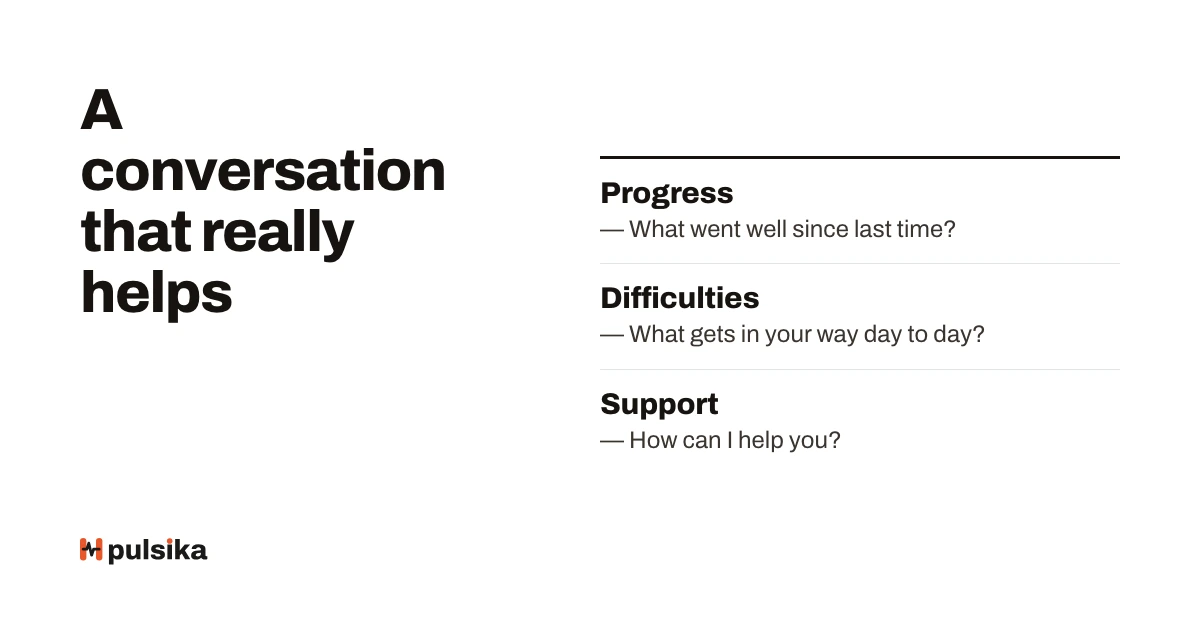
A one-to-one meeting (1:1) is a scheduled, regular and private conversation between a manager and a team member, in which the agenda belongs first of all to the employee: what is blocking them, what they are prioritising, how they are developing, what they need from the manager. It is not a status meeting, an annual appraisal or a disciplinary conversation.
The article gives you a 30-minute structure, a calculation of the time 1:1s take for teams of different sizes, a bank of questions by purpose and the version for shift teams.
Quick answer. Schedule 1:1s weekly or every two weeks, 20–30 minutes, at the same time. The employee proposes the topics, the manager listens more than they talk. A simple structure: how things are going, what is blocking them, the priorities until the next meeting, a development topic, the commitments written down. Do not cancel the meeting; move it. Do not use it for appraisals or sanctions.
Definitions: what a one-to-one is and what it is not
A one-to-one meeting is a recurring conversation between a manager and a direct report, intended to clear blockages, align priorities and support development. Andrew Grove, former chief executive of Intel, described it in High Output Management (1983) as “the subordinate’s meeting”, with its agenda and tone set by the subordinate.
The shared agenda is a list of topics both contribute to, filled in before the meeting. Commitments are the concrete actions agreed, with an owner and a deadline, checked at the start of the next meeting.
What a 1:1 is not
| Type of conversation | Purpose | Who leads | Why it is not mixed with a 1:1 |
|---|---|---|---|
| The 1:1 meeting | Blockages, priorities, development, the relationship | The employee proposes, the manager facilitates | — |
| The status meeting | Reporting progress on tasks | The manager | It uses up the time with information that could come in writing |
| The appraisal conversation | The level reached in the period, reward decisions | The manager, following the evaluation procedure | It shifts the focus to the rating; the person becomes defensive |
| The disciplinary investigation | Examining a possible misconduct | The person or committee appointed | It has its own legal procedure, with a written summons |
| On-the-spot feedback | A reaction to something that has just happened | Anyone | It does not wait for the 1:1; it is given when the thing happened |
A 1:1 can prepare an appraisal conversation, by gathering examples over the year, but it does not replace it. The prior disciplinary investigation has its own rules in Romania’s Labour Code (Codul muncii, Law no. 53/2003), art. 251: the employee is summoned in writing, with the subject, date, time and place of the meeting. A problem that may become disciplinary is not dealt with “informally” in a 1:1, but through the legal procedure, with the company’s lawyer.
Why it is worth the time
Gallup recommends that managers have one meaningful conversation per week with each team member, lasting 15–30 minutes. Gallup also reports that 80% of employees who say they received meaningful feedback in the past week are fully engaged. Gallup lists what makes a conversation count: recognition of recent work, collaboration and relationships, current goals, the length of the conversation and the person’s strengths.
Quality matters at least as much as frequency. Doctoral research by Jonathan Flinchum at UNC Charlotte, supervised by Steven Rogelberg, with 303 respondents, found that employee engagement depends more on the quality of 1:1s, especially on the manager’s relationship-oriented behaviours, than on their mere frequency. The author’s caveat: the effect appears when the meetings take place at least monthly.
Remember. The correlation between regular conversations and engagement does not prove that 1:1s produce it on their own. They create the opportunity; what happens in them, and after them, makes the difference.
How often and for how long: the manager’s budget
The frequency depends on the size of the team and on how new the person is in the role. The calculation below shows how much time per week each option takes. The figures are simple calculations, not norms.
| Team | Rhythm and duration | Calculation | Time per week |
|---|---|---|---|
| 5 people | Weekly, 30 min | 5 × 30 | 150 min (2.5 hours) |
| 8 people | Weekly, 30 min | 8 × 30 | 240 min (4 hours) |
| 8 people | Every two weeks, 45 min | 8 × 45 ÷ 2 | 180 min (3 hours) |
| 12 people on shifts | Every two weeks, 20 min | 12 × 20 ÷ 2 | 120 min (2 hours) |
| 15 people | Monthly, 30 min | 15 × 30 ÷ 4 (about four weeks a month) | around 113 min (approx. 1.9 hours) |
Above 10–12 direct reports, weekly 1:1s take up a large part of the manager’s week. The realistic solutions are a two-week rhythm, shorter meetings or a shift leader who takes over some of the 1:1s. People new in the role benefit from a more frequent rhythm in their first months.
The structure of a 30-minute 1:1
- Last time’s commitments (3 minutes). What was done, what was not and why. Start with the manager’s.
- How things are going (5 minutes). An open question, then listening. Do not move straight on to tasks.
- The employee’s topics (12 minutes). Blockages, decisions to take, frustrations, ideas. The manager asks and helps towards a solution, rather than taking the problem over by reflex.
- The priorities until the next meeting (5 minutes). What matters most and what can wait.
- A development topic (3 minutes). What the person wants to learn, what opportunity comes up in the coming period.
- The new commitments (2 minutes). Who does what, by when, written down by both.
The order can vary, but the employee’s topics come before the manager’s. If the manager has an urgent topic, they add it to the shared agenda beforehand, so the person is not caught off guard.
Practical tip. Keep the agenda in a shared document that both add to during the week. Topics written down as soon as they come up are not lost, and the person comes prepared. Grove recommended that the subordinate prepare an outline of the topics: otherwise, a manager with eight subordinates would prepare eight times, and each subordinate only once.
A bank of questions by purpose
| Purpose | Question | When to use it |
|---|---|---|
| Opening | “What took up most of your time this week?” | At every meeting |
| Blockages | “What would make your work easier if it disappeared tomorrow?” | When the person says it is “going well” but the results are late |
| Prioritisation | “If you could finish only one thing by Friday, what would it be?” | In busy periods |
| Support | “What do you need from me that you are not getting?” | Monthly |
| Development | “What would you like to be doing in a year’s time that you are not doing now?” | Quarterly |
| Feedback for the manager | “What should I do differently to make things easier for you?” | Monthly, once the relationship has settled |
| Retention | “What would make you think about leaving?” | Rarely and only once trust has been built; details in the stay interview |
1:1s for shift teams and teams without a desk
In shops, pharmacies, hotels or warehouses, people have no calendar and no desk. The 1:1 exists there too, in another form:
- Short and at a fixed time: 15–20 minutes at the start or end of a shift, paid as working time, not during the break.
- In a quiet place: not at the till and not in front of customers.
- With cover: someone takes over the post for the length of the conversation, otherwise the 1:1 is interrupted or postponed indefinitely.
- With notes on the phone: the commitments are written down straight away, even in three lines.
Hypothetical example. A store coordinator with 12 people on two shifts holds three 20-minute 1:1s on Tuesdays and Thursdays, at the shift change. In two weeks they reach all 12, with 2 hours a week, as in the table above.
Notes: what you keep and who sees them
Notes from a 1:1 about an employee are personal data. Keep facts and commitments, not interpretations about private life or health. The person has the right to obtain access to the data concerning them (GDPR Art. 15), so write as if they will read them. The simplest approach is for the notes to be shared: the employee sees what was written and can correct it.
Common mistakes
- The 1:1 cancelled at the first emergency. The message the person receives is that it does not matter. Correct it: move the meeting within the same week, do not cancel it.
- A status meeting in disguise. The manager goes through the task list. Correct it: status is sent in writing; the 1:1 starts with the employee’s topics.
- The manager talks the most. Correct it: open questions, then silence; the aim is to find out what you do not know.
- Negative feedback saved up for the 1:1. Correct it: a problem is discussed when it arises; the 1:1 is not a store of reproaches.
- Commitments with no trace. Correct it: write them down and check them at the start of the next meeting, starting with the manager’s.
- Using the 1:1 for sanctions. Correct it: misconduct follows the legal disciplinary procedure, not an informal conversation.
Frequently asked questions
How often should a one-to-one meeting take place?
Weekly or every two weeks is a suitable rhythm for most teams; Gallup suggests one meaningful conversation a week, of 15–30 minutes. For large teams or shift teams, every two weeks for 20 minutes is realistic. Monthly becomes too rare for day-to-day blockages, but it can work for people with a lot of experience and autonomy.
Who sets the agenda of a 1:1?
The agenda belongs first of all to the employee, who proposes the topics before the meeting. The manager adds their own topics to the same list, in good time, so the person is not caught off guard. Andrew Grove described the 1:1 as the subordinate’s meeting, with its agenda and tone set by the subordinate. A shared agenda document makes the rule easy to keep.
What do you do if the employee always says that “everything is fine”?
Change the question. Instead of “how is it going?”, ask what took up most of their time, what would make their work easier or what they would change if they were the manager. Answer for what you yourself promised last time, too. Trust is built over several meetings, not from a single question.
Can I discuss performance in a 1:1?
Yes, as part of the conversation about priorities and development: what is working, what can be improved, what support is needed. Do not, however, turn the 1:1 into an appraisal. The rating, the level and reward decisions are discussed in the appraisal conversation, following the company’s procedure, and misconduct follows the disciplinary procedure laid down by Romania’s Labour Code.
What happens to 1:1s when the manager has 15 people?
With 15 direct reports, weekly 30-minute 1:1s would take 7.5 hours a week. The realistic options are a two-week rhythm, 20-minute meetings or delegating some of them to a shift leader or a coordinator. Beyond a certain size, the real problem is the structure of the team, not the calendar.
Do I have to write down what was discussed?
Yes, briefly: the topics, the decisions and the commitments, with an owner and a deadline. Notes about an employee are personal data, and the person has the right to access them, so keep only facts. The simplest option is a shared document, which the employee also sees and can add to.
Is a 1:1 the same thing as a stay interview?
No. The 1:1 is a regular meeting about current work, blockages and development. The stay interview is a rare, prepared conversation about what keeps the person in the company and what would make them leave. Retention questions can come up occasionally in a 1:1, but the interview has its own structure and follow-up.
What to do next
Work out your time budget with the table above, choose the rhythm and schedule the first 1:1s for the whole team in the same week. At the first meeting, explain the rules: the agenda belongs to the person, the meeting is not cancelled, the commitments are written down.
- For the development plan that grows out of the development topics: the individual development plan.
- For the conversation about a performance score: scores people trust.
- For the conversation when results are poor: the evaluation conversation.
- For recognising work, the first element of a conversation that counts: recognition that counts.