

 Română
 English
 Deutsch
 Magyar
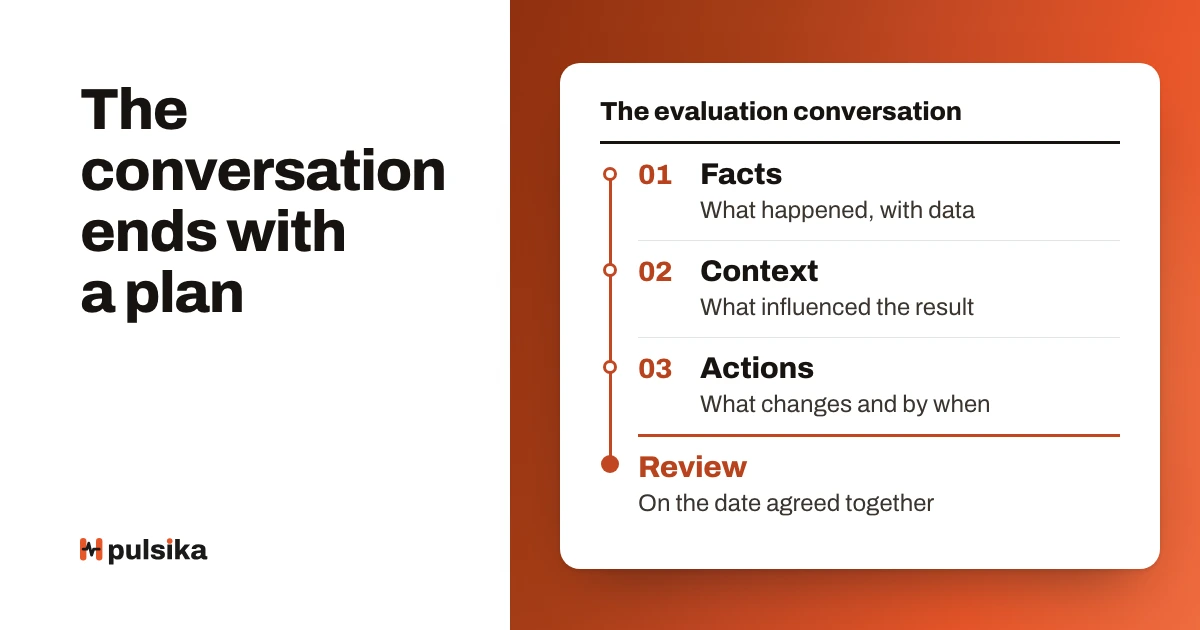
An evaluation conversation when results are poor has a single purpose: that the person leaves knowing exactly what is not working, why it matters, what is expected of them, by when and what support they will get. It is prepared with facts and figures, led by a clear structure and closed with a written improvement plan, followed up on fixed dates.
The article gives you the structure minute by minute, phrases to use and to avoid, a plan filled in on a fictitious example and, with the articles of Romania’s Labour Code, the difference between this conversation and the disciplinary procedure.
Quick answer. Prepare the period’s facts and figures, check the possible causes and schedule a private conversation of 45–60 minutes. Present the situation briefly, listen to the person’s explanation, agree together on 2–3 measurable changes, with deadlines and support, then confirm in writing. A performance conversation is not a disciplinary investigation and must not be mixed up with one.
The terms, in brief
- The evaluation conversation is the meeting in which the manager and the employee review a period’s results against the objectives and criteria set. When results are below expectations, its purpose is correction, not sanction.
- The performance improvement plan is a short document with 2–3 measurable changes, deadlines, the support offered and the review dates. It is a management practice; Romania’s Labour Code (Codul muncii, Law no. 53/2003) does not provide for it as such.
- The prior disciplinary investigation is the legal procedure through which the employer examines a disciplinary offence before applying a sanction (art. 251 of the Labour Code).
- Professional unsuitability is the ground for dismissal set out in art. 61(d): the employee is not professionally suited to the job they hold. Dismissal on this ground may be ordered only after a prior evaluation of the employee, under the procedure in the applicable collective agreement or, failing one, in the internal regulations (art. 63(2)).
Performance conversation, prior evaluation or disciplinary procedure?
Poor results are not, in themselves, a disciplinary offence. Romania’s Labour Code defines a disciplinary offence as a work-related act, committed with fault, by which the employee breaches the law, the internal regulations, the contract or the lawful instructions of their superiors (art. 247(2)). Someone who tries and does not succeed is not, as a rule, in that situation.
Things change when the poor result comes from a culpable breach of known rules, for example repeatedly refusing to apply a procedure. Then there may also be a disciplinary offence, with its own separate procedure. How a specific case is classified is for the company’s lawyer to decide, not for the manager during the conversation.
| Aspect | The performance conversation | The prior evaluation for professional unsuitability | The prior disciplinary investigation |
|---|---|---|---|
| Purpose | Correcting the results | Checking whether the employee is professionally suited to the job | Examining a disciplinary offence |
| Legal basis | The employer’s right to set objectives and evaluation criteria (art. 40(1)(f)) | Art. 61(d) and art. 63(2): the procedure in the applicable collective agreement or, failing one, in the internal regulations | Art. 247–252; without an investigation, the sanction is absolutely void, except for a written warning (art. 251(1)) |
| When | At the first signs and at every periodic evaluation | When results remain below requirements after support and a reasonable time (a management recommendation; the law sets no time limit) | When there is an act committed with fault |
| Possible outcome | Improvement plan, support, follow-up | The evaluation’s conclusion; on dismissal, the obligation to offer other compatible vacant jobs (art. 64(1)) | A disciplinary sanction (art. 248) or the case dropped |
Caution. The table briefly describes the text of Romania’s Labour Code, in the consolidated version of 27 April 2026; it is not legal advice. The professional evaluation procedure must be set out in the internal regulations (art. 242(i)) or in the applicable collective agreement. Before any step that may affect the contract, check the procedure, the time limits and the documents with the company’s lawyer. Do not use the performance conversation to obtain statements for a later disciplinary procedure.
How to prepare
Preparing takes longer than the conversation. A manager who comes with impressions gets disputes; one who comes with facts usually gets a conversation about solutions.
- Gather the period’s facts. The indicator figures for the last 3–6 months, compared with the target and with the team, plus 2–3 specific, dated examples.
- Check the data. Are values missing? Was the person on leave? Did the target change? One wrong figure cancels the conversation. The guide on scores people trust shows what the person must be able to check.
- Form hypotheses about the cause, not conclusions. Use the table below.
- Decide what you want to change: 2–3 results, not ten.
- Prepare the support you can offer: training, shadowing a colleague, time, tools.
- Schedule the conversation in a private place, with 45–60 minutes set aside, not at the end of a long shift. Say the subject in advance.
Possible causes and how to check them
| Possible cause | Checking question | What usually helps |
|---|---|---|
| Unclear expectations | Can the person say what is asked of them and how it is measured? | Clarifying the objectives and the examples of “good” |
| Insufficient competence | Have they had the training and practice they need? | Training, shadowing a colleague, practice with feedback |
| Resources or conditions | Do they have the stock, the tools, the schedule, the information? | Solving the organisational problem, not talking to the person |
| Motivation or fit with the role | Has something changed in their engagement? Does the role suit them? | A conversation about interests, possibly another role |
| Personal situation | Has something outside work come up that affects them? | Temporary flexibility, without asking for private details |
Do not ask about health or private life. If the person chooses to say something, listen and discuss what adjustments are possible; medical details do not go into the notes of the conversation.
The structure of the conversation, minute by minute
For a conversation of 45–60 minutes, a structure that leaves room for listening:
- The opening (2–3 minutes). State the subject directly: “I want us to discuss the results of the last three months and what we do next.” No long introductions.
- The facts (5 minutes). The figures and 2–3 examples, briefly. Do not interpret yet.
- The person’s view (10–15 minutes). “How do you see these results? What happened?” Listen without contradicting. Take notes.
- The causes, together (10 minutes). Go through the hypotheses. Separate what depends on the person from what depends on the organisation.
- What changes (10–15 minutes). 2–3 measurable results, with a deadline, plus the support offered. Ask the person to propose the first step.
- The consequences, said clearly (2–3 minutes). What happens if the plan succeeds and what happens if it does not, in the terms of the company’s procedure, without threats.
- The close (3–5 minutes). Summarise, set the first follow-up meeting and say when they will receive the plan in writing.
Practical tip. Describe behaviours, not the person. The Situation–Behaviour–Impact model, proposed by the Center for Creative Leadership, asks you to state the situation, the behaviour observed and its impact, then to ask about intent. A 1996 meta-analysis found that feedback improved performance on average, but more than a third of the interventions analysed lowered it, and the effect weakened as attention moved from the task to the person.
Phrases that help and phrases to avoid
| Instead of | Say | Why |
|---|---|---|
| “You don’t put in any effort.” | “Over the last three months you achieved 78%, 81% and 76% of plan; the team average was 98%.” | Facts can be checked; a label gets disputed |
| “You’re always late with the reports.” | “The stock report on 3 and 17 September came in after 12:00, and the deadline is 10:00.” | “Always” is refuted by a single exception |
| “Everyone complains about you.” | “I received two complaints in September, which I want us to discuss.” | Vague sources create mistrust |
| “You have to change.” | “By 30 November, I want you to reach at least 90% of plan. What would help you?” | A result, a deadline and support, not a general demand |
| “If not, we’ll see.” | “If at the January review the results are still below the targets in the plan, we will apply the evaluation procedure in the internal regulations.” | Clear consequences are fair; vague ones sound like a threat |
The improvement plan: a filled-in model
Hypothetical example. Fictitious data. A sales consultant in one of a chain’s shops achieved 78%, 81% and 76% of the monthly plan in July, August and September (an average of 78.33%), against a team average of 98%. The data was checked: no working days were missing, and the target was the same as for colleagues. The conversation showed two likely causes: poor knowledge of a new range and rare recommendations of complementary products.
| What must change | How we measure | Now | Target and deadline | Support offered | Review |
|---|---|---|---|---|---|
| Achieving the sales plan | Net sales against the monthly plan | 78.33% (3-month average) | At least 85% in November and 90% in December | Monthly plan split into weeks, discussed on Mondays | Weekly, 15 minutes |
| Knowledge of the new range | The range test, a mark out of 100 | Not tested | At least 80 by 15 November | The range course and two shifts alongside an experienced colleague | The test result |
| Recommending complementary products | The coordinator observing 10 customer interactions | 2 out of 10 interactions with a recommendation | At least 6 out of 10 by 15 December | Practice at the start of the shift, with examples | Observations on 1 December and 15 December |
The plan has three rows, not ten, and each row has a starting figure. The deadlines are long enough for a real change and short enough not to get lost.
Following up and closing the plan
- Short, regular meetings. 15 minutes a week in the first month, then every two weeks. What worked, what did not, what helps.
- Reviews on fixed dates. The same figures, calculated the same way, at every review.
- A written close. At the end, one of three conclusions: the plan succeeded and is closed; real but incomplete progress, with the deadline extended once only; the results stayed below requirements, and the company decides the next step under its procedure.
- Recognising progress. A result achieved is said explicitly. The plan is not just an archive of failures.
Difficult reactions during the conversation
- Denial: “The figures are wrong.” Note exactly what the person disputes and check it after the conversation; do not debate the figure on the spot.
- Anger: let the reaction pass, acknowledge it (“I can see this upsets you”), go back to the facts. If the conversation can no longer continue, reschedule it within 1–2 days.
- Tears or silence: offer a break. Do not rush the close and do not withdraw the requirements to end the moment.
- Blaming others: separate what depends on the organisation (which you solve) from what depends on the person (which you ask for).
Common mistakes
- The conversation put off until the annual evaluation. Fix: talk at the first signs; a poor month is easier to recover than a year.
- The praise sandwich. The important message gets lost between two compliments. Fix: state the problem directly, then acknowledge what is going well, separately.
- Too many targets in the plan. Fix: 2–3 changes, measurable.
- A plan without support. A plan that only asks for results is a warning, not a plan. Fix: every row has its support.
- Mixing it with the disciplinary procedure. Fix: keep the performance conversation separate from any disciplinary investigation and ask the lawyer’s advice.
- No follow-up. Fix: the review dates go in the calendar at the end of the conversation.
- Subjective notes. What you write may be read by the person. Fix: facts, figures, dates, not labels. For the typical errors of judgement, read about errors in employee evaluation.
How Pulsika helps
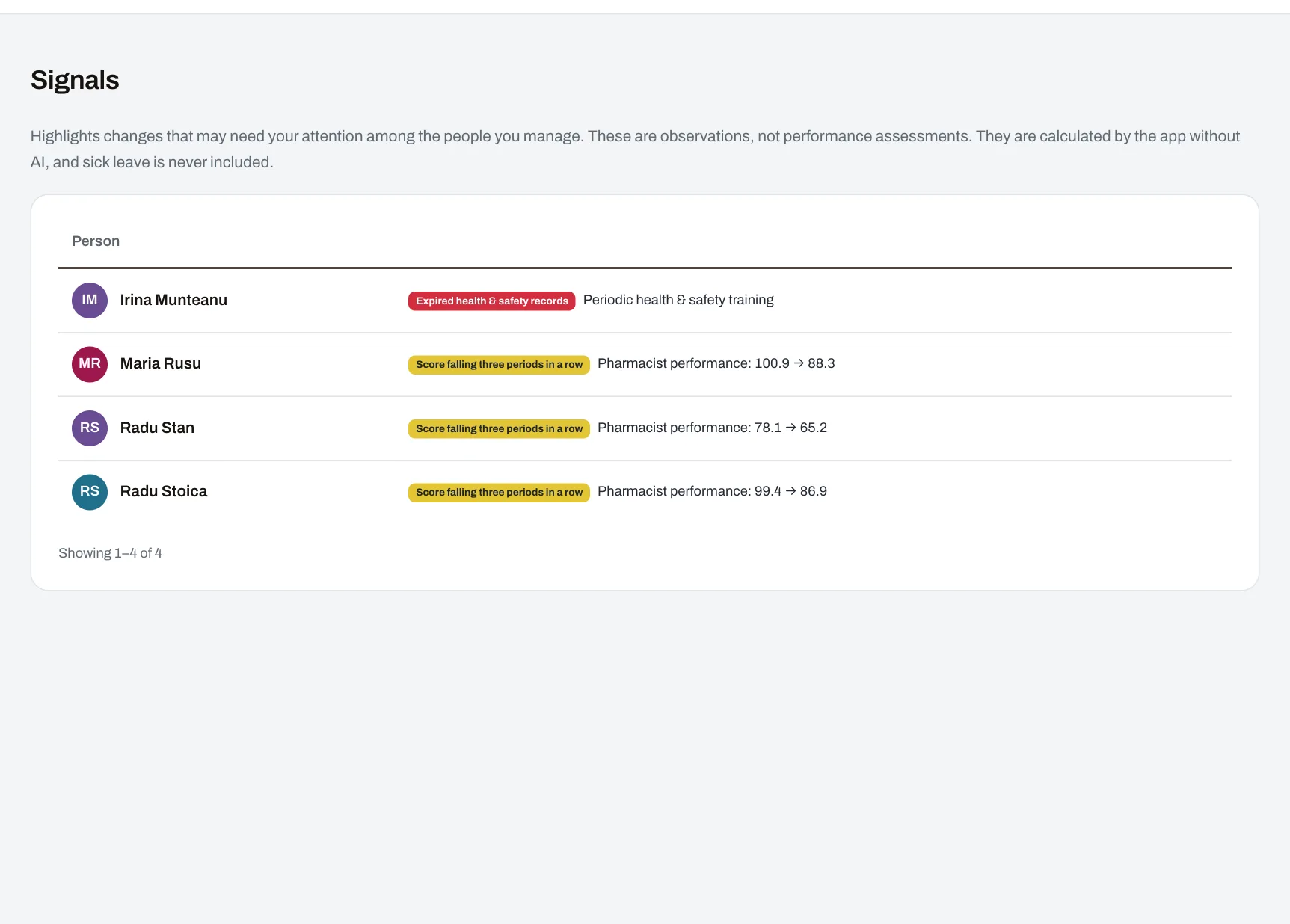
In Pulsika, the conversation usually starts from Signals, the page that shows a manager the people in their reach whose KPI score has fallen in each of the last three periods, by at least 10 points in total (if they have the right to see the team’s scores), overdue training and expired mandatory health and safety training or checks. Signals are calculated without AI, and sick leave is not taken into account.
- The facts of the conversation: the score page shows what it is made of, how much each part adds, the figures used and the trend over time.
- The written evaluation: in Evaluations, the manager can leave a comment on each criterion and a general one; when the grid shows the evaluation to the person evaluated, they confirm they have read it and, if the grid allows, reply once.
- Support: whoever runs training can assign a course to a single person, with a deadline, and the person finds it in “My courses and tests”.
Frequently asked questions
How often should I talk to an employee whose results are poor?
The first conversation takes place as soon as you see a pattern, usually after two or three periods below target. Then come short meetings of 15 minutes, weekly in the first month and every two weeks after that. The plan’s formal reviews have fixed dates, set at the end of the first conversation and entered in both people’s calendars.
Does the employee have to sign the improvement plan?
Romania’s Labour Code does not provide for an improvement plan, so it does not provide for signing one either. It is good practice to ask for confirmation that they have received the plan and, separately, to leave them room for comments. If the evaluation procedure in the internal regulations requires signatures or forms, follow it exactly and check the details with the company’s lawyer.
How long does a performance improvement plan last?
The usual length is 30–90 days, depending on how long the change needs to show in the figures. A monthly sales cycle needs at least two months; a customer service habit can be checked in a few weeks. A deadline that is too short makes the plan a formality, and one that is too long makes both sides forget it.
Can I dismiss an employee for poor results?
Romania’s Labour Code allows dismissal for professional unsuitability (art. 61(d)), but only after a prior evaluation of the employee, under the procedure in the applicable collective agreement or in the internal regulations (art. 63(2)). The employer must also offer other compatible vacant jobs (art. 64). Check every step with the company’s lawyer.
What do I do if the employee disputes the figures?
Note exactly which figure they dispute and why, then check it with whoever owns the data source, after the conversation. If the figure was wrong, correct it and tell the person what changed. If it was right, show the document. Do not debate the figure on the spot: the conversation moves from solutions to bookkeeping and never comes back.
Are poor results during the probation period handled the same way?
No. During or at the end of the probation period, the contract may be ended by written notice, without a notice period and without giving reasons, at the initiative of either party (art. 31(3) of Romania’s Labour Code). A fair conversation about results is still useful, so that the person knows where they stand.
Should someone from HR be present?
For the first performance conversation, usually not: a meeting between the manager and the employee is more open. Having HR there is useful when the conversation may lead to a formal procedure, when the relationship is tense or when the manager has little experience. If the company’s procedure requires a particular participant, follow it.
What to do next
Choose a person whose results are below target, and fill in the causes table and the first row of the plan before the conversation. For the regular conversations that prevent situations like this, read about one-to-one meetings, and for the long-term plan, about the individual development plan. To see the signals and evaluations on fictitious data, enter the demo company as a unit manager.