

 Română
 English
 Deutsch
 Magyar
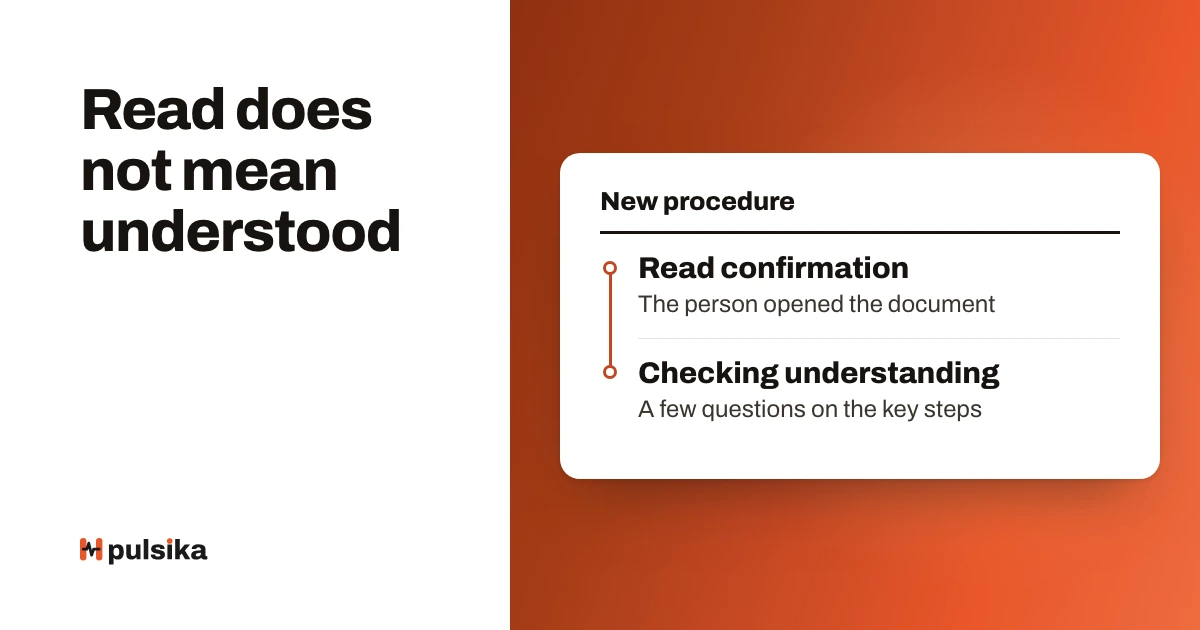
To know that a new procedure has been understood in every location, you need four different pieces of evidence: that the message arrived, that people read it, that they can explain it and that they apply it. A read confirmation covers only the second step. Understanding is checked with a short test or by explaining it in one’s own words, and application by observation on the job.
This article gives you a launch plan that starts a week before the procedure takes effect and ends three weeks after, a comparison of the checking methods, a five-question test template and an example calculated on 20 units, which shows where the procedure gets lost between “I have read it” and “I apply it”.
Quick answer. Launch the procedure in four steps: publish it in a single place, with a date it takes effect; ask for read confirmation; check understanding with a test of 3–5 questions on real situations or by asking people to explain it at the briefing; then check application on the ground after 2–3 weeks. Each step proves something different; confirmation alone does not prove understanding.
What it means for a procedure to be understood
A procedure is the description of the steps by which an activity is done: what is done, in what order, by whom and when. A new procedure changes a behaviour; that is why its success is measured on the ground, not in the number of messages sent.
- Informing means the procedure has reached every person affected, on a channel they use.
- Read confirmation is the person’s statement that they have read the text. It shows who has not opened the message, not who has understood it.
- Understanding is the person’s ability to say what they do in a concrete situation, in their own words.
- Application is the behaviour observed at work, after the procedure has taken effect.
The “teach-back” method, used in healthcare, starts from the same distinction: you ask the person to say in their own words what they have to do, and the “show-me” variant asks them to demonstrate it. The US Agency for Healthcare Research and Quality (AHRQ) stresses that you are checking how well you explained, not testing the person (AHRQ, Teach-Back Method: Tool 5).
Five checking methods: what each one proves
No method covers everything. The table helps you choose the right combination for how important the procedure is.
| Method | What it proves | What it does not prove | Effort | When to use it |
|---|---|---|---|---|
| Read confirmation | Who opened it and declared they had read it; the time of confirmation | Understanding, application | Low | Any procedure that changes something in people’s work |
| Short test (3–5 questions on situations) | That the person chooses the right step in typical situations | That they also do it under pressure, on shift | Low–medium | Procedures with risk: money, safety, personal data, complaints |
| Explaining in one’s own words at the briefing | That the person can rephrase the steps; where the text is unclear | The individual result on record, unless you write it down | Low | Shift teams, people who rarely read on their phone |
| Demonstration (“show me”) | That the person does the physical steps correctly | That they also do them when nobody is watching | Medium | Equipment, handling, the till, hygiene |
| Check on the ground (checklist, photos) | That the procedure is applied in the unit, after launch | Exactly who has not understood | Medium–high | Procedures on which a visible result depends: displays, cleanliness, documents |
Remember. A 100% read confirmation and 60% application do not contradict each other. The first measures a click, the second a behaviour. Report them separately.
What the law requires and what is a recommendation
Most operational procedures (returns, opening the unit, receiving goods) have no form of communication imposed by law. For them, checking understanding is a management decision.
Two exceptions matter. If the procedure changes the internal regulations, Romania’s Labour Code (Codul muncii) requires the change to follow the same information procedure as the regulations themselves (Art. 244). That means bringing it to the attention of every employee, with proof that the obligation was met, on paper or electronically, if the document can be stored and printed (Art. 243(1)–(2)). The regulations take effect for the employee from the moment they are made aware of them (Art. 243(3)) (Law no. 53/2003, consolidated text, checked on 18 October 2026).
If the procedure concerns occupational health and safety, the training has its own rules, described in the guide on training records for inspections.
Whether a confirmation in an application counts as proof in your case is a question for the company’s lawyer.
How to write the procedure so it can be checked
A procedure that is hard to check is usually hard to apply. Before launch, check the text against four criteria.
- A single place and one version. The procedure lives in the knowledge base, with the date it takes effect and the date of the last update. The announcement links to it rather than copying it.
- Observable steps. “Scan the receipt before opening the return” can be checked; “Take care with returns” cannot.
- What has changed, set out separately. The first paragraph says what is different from the old procedure. People who know the old one look for the difference.
- The edge cases. What you do when the customer has no receipt, when the system is down, when the manager is away. That is where most questions come up.
The structure of the knowledge base, article owners and their review are the subject of the article on the internal knowledge base.
The launch plan: one week before, three weeks after
- Day −7: unit managers get the procedure first. A 20-minute meeting on what is changing, why, and the answers to the likely questions. The managers will explain it at the briefing.
- Day −5: publish the procedure and the announcement with confirmation. The announcement says what is changing, from when, what each person has to do and by when they confirm.
- Days −5…−1: explaining at the briefing. At the start of each shift, the manager asks a colleague to state the steps in their own words. What nobody can explain is a problem with the text, not with the people.
- Day 0: the procedure takes effect. Send a reminder to those who have not confirmed and ask the managers why confirmations are missing (no account, on leave, night shift).
- Days 1–7: a short test for procedures with risk, with 3–5 questions on situations. Analyse the results by question, not only by person.
- Days 14–21: a check on the ground with a list of 3–5 observable points, in every unit, by someone who does not run the unit. For what can be seen (displays, labels, notices), ask for photos.
- Day 21: close the loop. Rewrite the step most people got wrong, add the questions received to the procedure’s frequently asked questions section and announce what has been clarified.
The short test: how to build it
A test that checks understanding has 3–5 questions, each on a situation from the shift. Recall questions (“On what day does the procedure take effect?”) check attention, not understanding.
| Type of question | Example (fictitious returns procedure) | What it checks |
|---|---|---|
| Situation with a choice | “A customer wants to return a product without a receipt, paid for by card. What do you do?” — four options, one correct | The most frequent edge case |
| Order of the steps | “Put in order: scan the receipt, check the product, issue the returns document, refund the money” | The steps in the correct sequence |
| True / false | “The manager must approve any return over 500 lei.” (True in the fictitious procedure) | Thresholds and approvals |
| Who is responsible | “Whom do you tell if the returns system is not working?” | Escalation |
| Short free answer | “Say in two sentences what has changed compared with the old procedure.” | Understanding of the difference (marked by a person) |
Practical tip. Decide in advance what you do about people who do not pass: a conversation with the manager and a second attempt, not a sanction. A test seen as a disciplinary tool produces copied answers, not understanding.
Worked example: where the procedure gets lost
Hypothetical example. A fictitious chain of 20 shops launches a new returns procedure for 160 people. The figures are invented, to show the calculation.
- Confirmation within 7 days: 152 of 160 confirmed, that is 152 / 160 = 95.0%.
- Test passed at the first attempt (five questions, passed with at least four correct answers): 141 of the 152 who confirmed, that is 141 / 152 = 92.8%.
- Question 3 (manager approval above 500 lei): answered wrongly by 58 of 152, that is 38.2%. The other questions have under 10% wrong answers, so many of those who got it wrong still passed the test.
- Check on the ground after 3 weeks: 15 of 20 shops apply all the steps observed, that is 15 / 20 = 75.0%.
Reading the results: the confirmation and the test look good, but a quarter of the shops do not apply the procedure. Question 3 points to the same weak spot: the approval threshold was written in a footnote. The correction concerns the text of the procedure, not the people. Three different rates, reported separately, say more than a single “95%”.
For larger training programmes, evaluation by level (reaction, learning, behaviour, results) is described in the article on checking whether training worked.
Common mistakes
- Confirmation reported as “the procedure has been understood”. Fix: report the confirmation, the test and the check on the ground separately.
- The procedure sent as text in a message. A month later, three versions are going round. Fix: a single place, with the update date, and the announcement only links to it.
- Managers find out at the same time as the team. They cannot answer questions at the briefing. Fix: the meeting with managers at least a week beforehand.
- A recall test. Questions about dates and article numbers do not show what the person does on shift. Fix: questions on situations.
- The check on the ground done by the unit’s manager. It is a self-check, useful but not independent. Fix: an area manager or a colleague from another unit.
- The loop is never closed. The mistakes from the test and from the ground do not make it back into the text. Fix: a review of the procedure three weeks after launch.
How to run the launch in Pulsika
- The procedure lives in the knowledge base, for the whole company or only for the units, areas, departments, job titles or roles concerned. When you publish, you can send the audience a notification; the article shows the date and author of the last update and how many times it has been read, and those who manage the knowledge base see how many readers found it useful.
- Read confirmation is requested on an announcement in the Social feed, with a link to the article (knowledge base articles do not have their own confirmation). The author sees who has confirmed and who has not, exports the list to CSV and sends a reminder by hand, at most once every 20 hours.
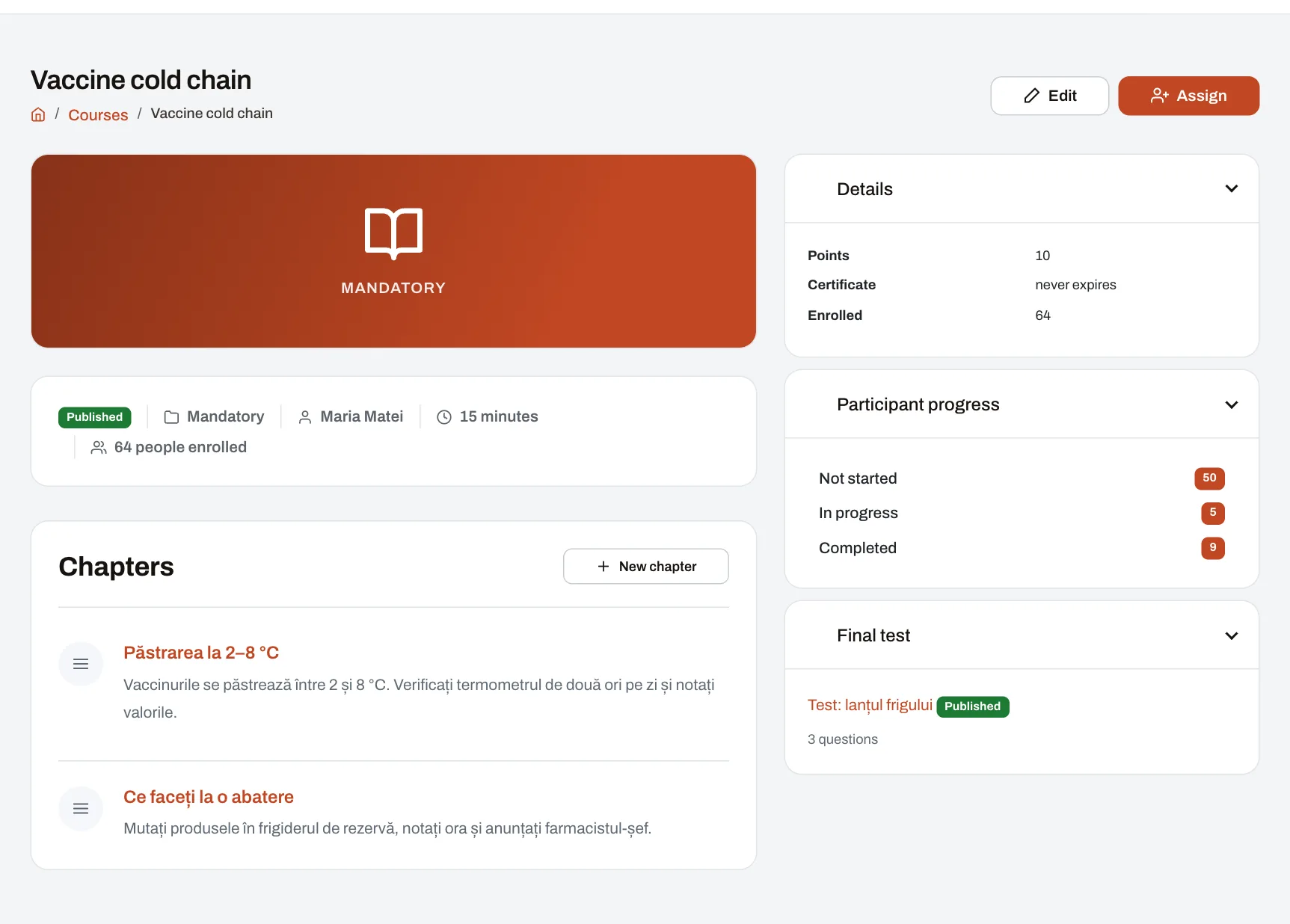
- The test is set up as a short course in Training and tests: single-choice, multiple-choice, true/false or free-answer questions, a pass mark, a maximum number of attempts and, optionally, questions drawn at random at each attempt. The course is assigned by job title, unit or person, with a deadline.
- The check on the ground is done with an audit against a checklist, with photos of findings and an action plan; an audit done by someone who works in or runs the unit is marked “self-check”. For what can be seen, photo reporting asks every unit for photos, with a deadline.
Frequently asked questions
Is read confirmation enough for a new procedure?
Read confirmation is enough only as proof that the person declared they had read it. For procedures with a risk to money, safety or personal data, add a short test or explaining at the briefing and a check on the ground after two or three weeks. For the internal regulations and health and safety training, the form of the proof is set by law, to be checked with your lawyer.
How many questions should the test have?
A test that checks understanding usually has three to five questions, one for each important step or edge case. A longer test turns into a training session and makes it less likely to be completed on shift. If the procedure has more than five critical points, split it into two launches or check the rest by observation.
What do we do with employees who do not pass the test?
First talk to them and to their manager, then offer a second attempt. Look at which question they got wrong: if many people get the same question wrong, the problem is the text of the procedure. A test used as a sanction makes people copy answers, and the results no longer show what has been understood.
Who does the check on the ground?
Ideally, the check on the ground is done by someone who does not run the unit: the area manager, an internal auditor or a manager from another unit. A check by the unit’s own manager remains useful as a daily self-check, but it should not be reported as an independent result. Use the same short list of observable points in every unit.
How long after launch do we check application?
Checking application makes sense two to three weeks after the procedure takes effect. Earlier, you are still observing the settling-in period; later, deviations have become habits. For procedures applied rarely, for example stocktaking, check at the first real application and note what was unclear for next time.
How do we find out which part of the procedure is unclear?
Analyse the test results by question, not only by person, and note the questions raised at the briefing and on other channels. A question got wrong by more than a third of people points to a step that is written unclearly or hidden in the text. Rewrite that step, announce the correction and check again at the next visit on the ground.
Do we need to ask for confirmation for every update to the procedure?
No. Ask for confirmation only when the update changes what the person does: a new step, a threshold, a person responsible. Wording corrections are published without confirmation, with the update date visible. Confirmations requested too often get clicked without reading and lose their value for the procedures that really matter.
What to do next
Choose the next procedure you will launch and write down three things for it: what proves it has been read, what proves it has been understood and what you will observe on the ground. For the calendar the launch fits into, use the internal communication plan and the XLSX template, and for the channel rules, the guide on chat groups. Confirmations, courses with tests and audits can be seen in the demo company.