
 Română
 English
 Deutsch
 Magyar
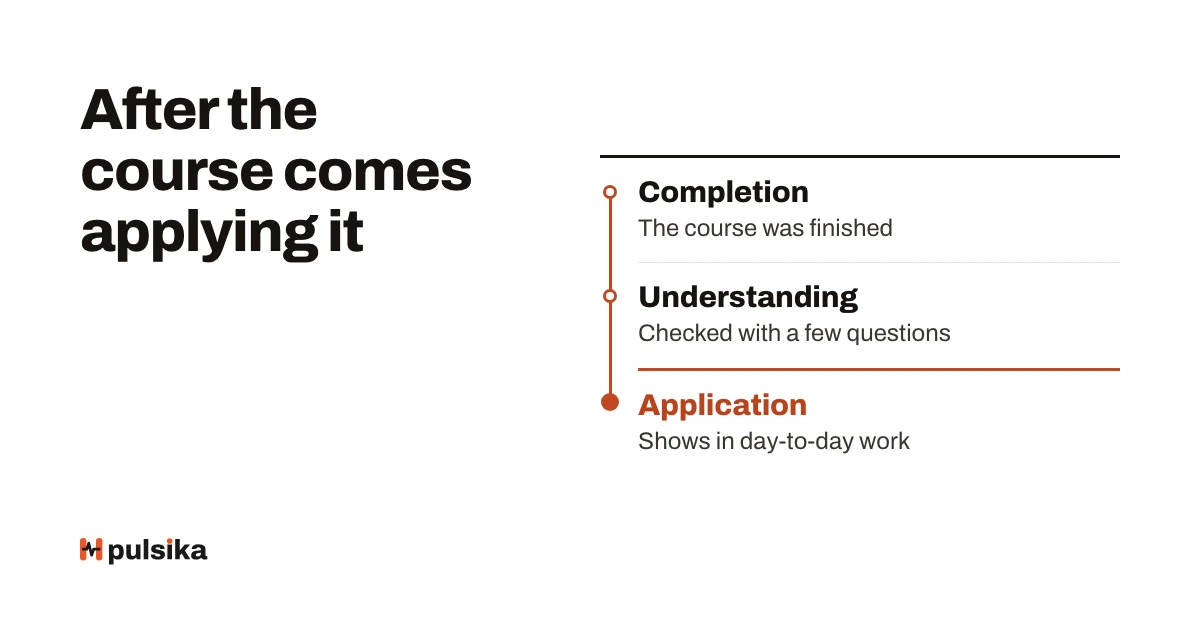
A training course has worked if people find it useful, have learned what they needed to, do things differently at work and an effect shows up in one of the company’s indicators. These are the four levels of the Kirkpatrick model: reaction, learning, behaviour, results. In practice, evaluation often stops at the first two, which are the easiest to measure.
This guide shows what each level proves and what it does not, how to build a checking plan starting from the result you want and a complete example, with calculations: a test before and after, a retention test at 30 days, observation on the job and an indicator compared with a group not yet trained.
Quick answer. Check whether training worked on four levels: the participants’ reaction (perceived usefulness), learning (a test before, after and at 30 days), behaviour on the job (observation against a list of critical steps) and results (an indicator before and after, compared with an untrained group). Set the indicator and the thresholds before the training.
Definitions
- Training effectiveness is the extent to which training produces the change it aims for: knowledge, behaviour on the job and results.
- The Kirkpatrick model consists of four levels of training evaluation, proposed by Donald Kirkpatrick in a series of articles published from 1959 onwards: reaction, learning, behaviour and results.
- Training transfer is applying on the job what was learned, in a way that lasts over time.
- The retention test is a test given some time after the training (for example, after 30 days) to see what has been kept.
- The comparison group consists of similar people or units that have not yet received the training and against which you compare how the indicator moves.
The Kirkpatrick model in brief
Kirkpatrick Partners, the company that develops the model today, defines the four levels as follows (kirkpatrickpartners.com):
- Reaction: the degree to which participants find the experience favourable, engaging and relevant to their jobs.
- Learning: the degree to which participants acquire the intended knowledge, skills, attitude, confidence and commitment.
- Behaviour: the degree to which participants apply the critical behaviours on the job and are supported and held accountable for doing so.
- Results: the degree to which the targeted organisational outcomes occur as a result of the training and the support provided.
The current version of the model asks for planning to start with level 4: which result you want to change and why. The working environment can support or block progress at every level. Other authors have proposed a fifth level, return on investment, calculated in money (Jack Phillips).
What each level proves and what it does not
| Level | What you measure | What it proves | What it does not prove |
|---|---|---|---|
| 1. Reaction | A questionnaire at the end: usefulness, relevance, intention to apply | How the training was perceived; what needs fixing in it | That people learned or will apply it |
| 2. Learning | A test before, after and at 30 days; a practical demonstration | What people know on a given date | That they apply it on the job; that they are competent |
| 3. Behaviour | Observation against a list of steps, at 30–60 days | What people actually do, in real conditions | That the change produces the result you want |
| 4. Results | An indicator before and after, with a comparison group | That the indicator moved more where training took place | That the training alone produced the difference |
Remember. A passed test does not guarantee competence, and a read confirmation does not prove understanding. Each level answers a different question; none of them replaces the others.
Level 1: ask about usefulness, not only about satisfaction
Research distinguishes between affective reactions (“I liked it”, “the trainer was good”) and utility reactions (“it will help me in my work”). A summary of meta-analyses published by the Quality Improvement Center for Workforce Development shows that reactions are only modestly related to immediate knowledge and unrelated to knowledge after a period of time; utility reactions have a modest link with transfer to the job, and affective ones have none (QIC-WD, 2022, based on the studies by Sitzmann et al., 2008, and Blume et al., 2010).
Four usefulness questions, on a scale from 1 to 5:
- “I will use what I learned in my first week at work.”
- “The examples in the training resemble the situations I come across.”
- “I know whom to ask if I struggle to apply it.”
- “I feel able to apply the procedure on my own.” (self-efficacy, which the same summary links to learning and transfer)
Level 2: a test before, after and at 30 days
A single test at the end shows what the person knows at that moment. Three measurements show more: the initial test tells you where the group starts from, the final test how much it gained and the retention test how much it kept.
- Use situational questions (“A customer brings back a product without a receipt. What do you do first?”), not questions that test definitions learned by heart.
- Use different versions for the initial, final and retention tests, from the same question bank, so that the result does not just reflect memorised questions.
- Set the threshold beforehand and say what happens below it: going over a chapter again, not a sanction.
Level 3: observation on the job
Behaviour is checked where it happens. Write the list of the task’s critical steps (usually 5–8), then a trained observer watches each person in a real situation, 30–60 days after the training.
- Who observes: the direct manager or an experienced colleague who has received the same list and an example of how to score it.
- What they record: each step done or not done, not a general impression.
- What comes next: feedback on the spot and, for the steps missed by many people, a correction to the training or to the process.
People often work differently when they know they are being observed. Repeat the observation or combine it with system data (for example, cancelled transactions) so that you do not rely on a single day.
Level 4: the indicator and the comparison group
Choose the indicator the training should move before you design it. Measure it over the same length of time before and after. To separate the effect of the training from the other changes (season, campaigns, new staff), train some of the units first and compare them with those trained later.
Correlation does not prove causation. Even with a comparison group, the result is an estimate. Say so in the report and do not present the difference as the certain effect of the training.
A complete example: training on the returns procedure
Hypothetical example. Fictitious data. A retail chain with five shops introduces a new returns procedure with six steps. Three shops (group A, 24 sales assistants) are trained in March; the other two (group B) in June. The indicator chosen before the training: the percentage of returns with errors (wrong amount, a return without the receipt checked, a product not recorded).
Level 1. Of the 24 participants in group A, 22 completed the questionnaire. To “I will use what I learned in my first week”, 19 answered 4 or 5: 19 ÷ 22 = 86%.
Level 2. The average on the initial test was 58%, on the final test 86% and on the retention test, at 30 days, 79%. The immediate gain is 28 percentage points, and retention loses 7. With an 80% threshold, 21 people out of 24 passed the final test (87.5%), but only 16 the retention test (66.7%).
Level 3. The managers observed 20 of the 24 sales assistants during a real return, in April. 15 did all six steps: 15 ÷ 20 = 75%. Of the 5 incomplete observations, 4 missed the same step: checking the receipt in the system.
Level 4. Returns with errors, in January–February (before) and April–May (after):
| Group | Before (Jan.–Feb.) | After (Apr.–May) | Change |
|---|---|---|---|
| A, trained in March | 48 of 800 = 6.0% | 30 of 750 = 4.0% | −2.0 percentage points |
| B, not yet trained | 30 of 500 = 6.0% | 27 of 540 = 5.0% | −1.0 percentage point |
| Difference A − B | — | — | −1.0 percentage point |
Errors also fell in the untrained shops, probably for other reasons (the written procedure was sent to everyone, and April has a different volume). The estimate of the training’s effect is the difference between the groups: about one percentage point. Over 750 returns in two months, that means around 7–8 fewer returns with errors. The numbers are small, so the conclusion stays cautious.
What the company decides from the four levels: the reaction and the final test look good, but retention and observation show the same weak point, checking the receipt. The course for group B gets an exercise on this step, and a short checklist is added at the till. Retention and observation are repeated after group B is trained.
How to build the checking plan in seven steps
- Start from the result. Which indicator needs to change, and by how much? If you cannot find one, ask yourself whether training is the right answer.
- Write down the critical behaviours that should move the indicator. They become the observation list.
- Set what people need to know for those behaviours. That is what you write the tests from.
- Measure beforehand: the indicator over the last few months and the initial test.
- Train in stages, if you can, so that you have a comparison group.
- Measure afterwards: the questionnaire at the end, the final test, the retention test at 30 days, the observation at 30–60 days, the indicator over the same length of time as before.
- Decide: what you change in the training, in the process or in the managers’ support. Write the decision next to the figures.
Practical tip. Put the checking plan on a single page, with one row per level: what you measure, how, when and who is responsible. If a row stays empty, you have found out in advance what you will not be able to say afterwards.
What the law requires and what remains a recommendation
Romania’s Labour Code (Codul muncii, Law no. 53/2003) provides that vocational training and the assessment of knowledge are based on occupational standards and that an employer with more than 20 employees draws up and applies a vocational training plan every year, after consulting the trade union or the employees’ representatives (Art. 192(2) and Art. 195, checked on the Legislative Portal on 18 October 2026). The law does not require effectiveness to be measured on the four levels: that is a management practice.
Caution. Occupational health and safety training has its own rules for how it is delivered, checked and recorded. It is covered in the guide on training records for inspections; the method here can complement those rules, not replace them.
How to do the checking in Pulsika
The Training and tests module covers level 2 and the follow-up, and other modules help with levels 1, 3 and 4:
- Tests: a course can have a final test, and tests can also stand alone. Each test has a pass mark (70% by default, changeable in the settings), a number of attempts, a time limit and, optionally, a number of questions drawn at random from the bank at each attempt. Free-text answers are marked by a person with the right to grade them.
- The initial and retention tests: assign stand-alone tests, separate from the final test (a test can be duplicated, and the copy edited to have a different set of questions), with the “Available from” date set, for example, to 30 days after the course.
- Follow-up: an assignment’s list shows each participant’s status, progress, score, attempts and deadline, and can be exported to Excel. The indicators “Training completed on time”, “Average test score” and “Overdue training” can go into scorecards, per person or per unit.
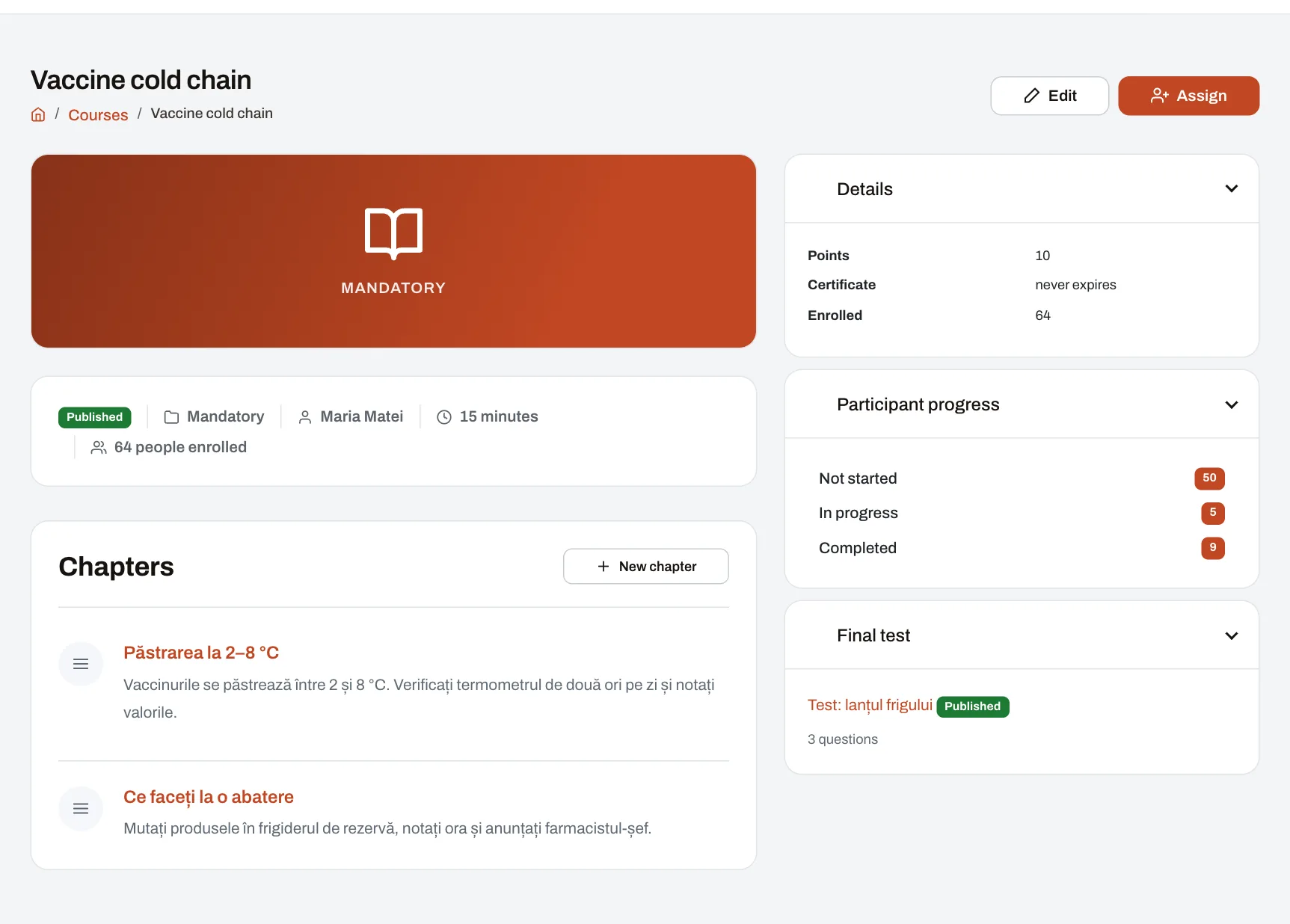
- Observation (level 3): an evaluation form in Evaluations can hold the critical steps as a checklist, each with its own points; the manager fills it in monthly or quarterly for their people, and the result counts in the score. For checks per unit rather than per person, internal audit has scored checklists with critical points.
- Reaction (level 1): a survey with questions on a 1–5 scale, addressed to a unit, a department, a job title or an area; for anonymous ones, the results appear after closing and only from 5 responses upwards.
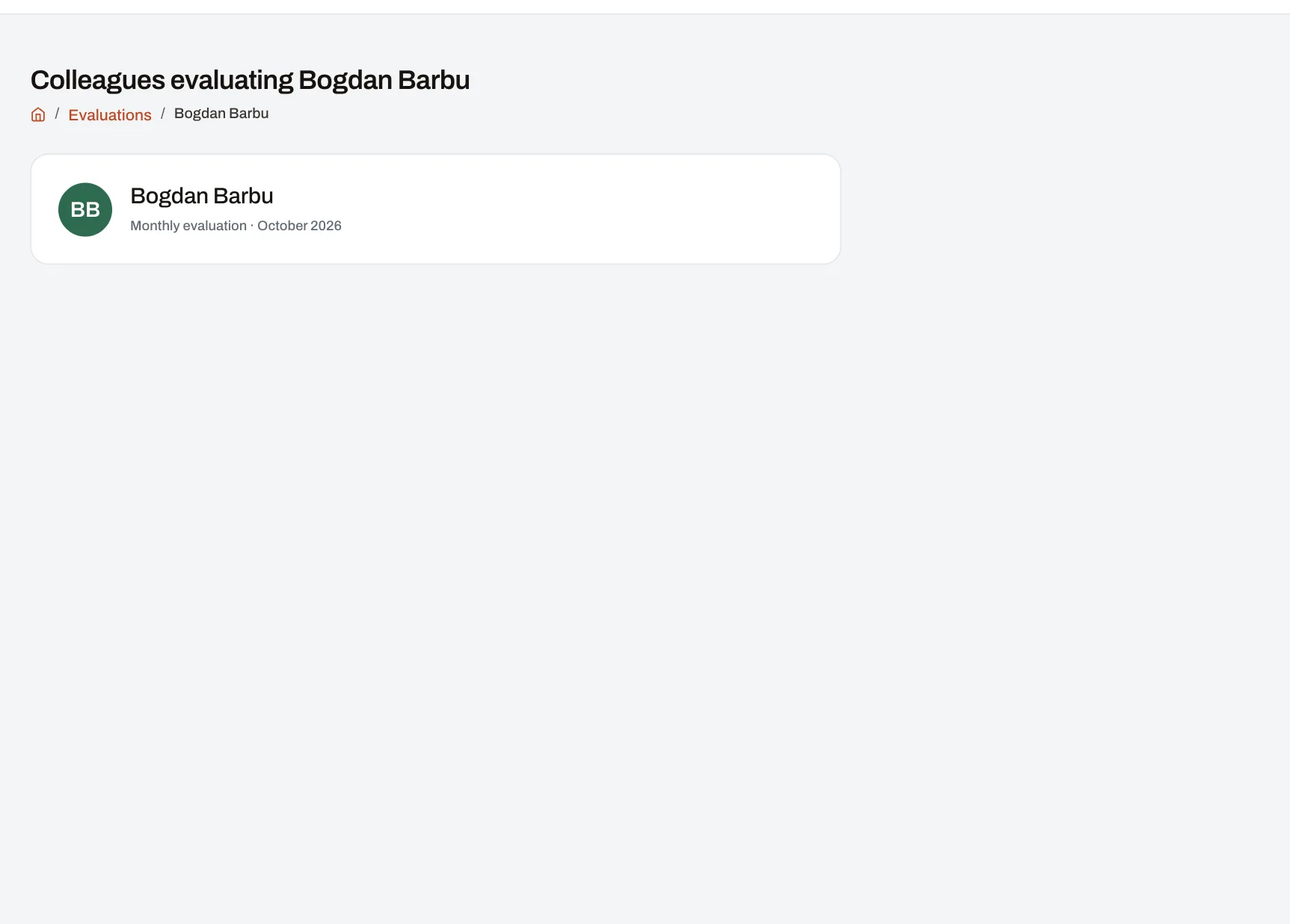
What the application does not do: it does not automatically calculate the difference between the trained group and the comparison group; you compare the result indicator yourself, by unit. To see courses, tests and evaluations with data, go into the demo company.
Common mistakes
- Only the satisfaction questionnaire. Fix: usefulness questions plus at least one test and one observation.
- The final test used as proof of competence. Fix: retention at 30 days and observation on the job.
- The indicator chosen after the training, from among those that moved. Fix: choose it and record its value beforehand.
- No comparison group, so the whole fall in errors is credited to the training. Fix: training in stages, with comparable units.
- Observation without a list. Fix: written critical steps, the same way of scoring for every observer.
- Poor results blamed on the people alone. Sometimes the problem is the process or a lack of support from the manager. Fix: also ask what got in the way of applying it.
Frequently asked questions
What is the Kirkpatrick model?
The Kirkpatrick model is a framework for evaluating training on four levels: the participants’ reaction, learning, behaviour on the job and results for the organisation. Donald Kirkpatrick published it in a series of articles that began in 1959. The current version asks for planning to start with level 4, that is the result you are aiming for, and then work down to the other levels.
Is a feedback questionnaire at the end of the course enough?
No. The questionnaire shows how the training was perceived and what needs improving in it. Reactions are only modestly related to immediate knowledge and unrelated to knowledge after a period of time. Questions about usefulness have a modest link with applying it on the job, those about satisfaction none, but even the former do not replace the test, the observation and the indicator.
When is the retention test done?
A practical interval for the retention test is 30 days after the training, when people have had the chance to apply it but months have not gone by. Use questions different from those in the final test, from the same bank and of the same difficulty. The difference between the final test and the retention test shows what needs refreshing.
How do you measure a change in behaviour on the job?
Write the list of the task’s critical steps, then a trained observer watches each person in a real situation, 30–60 days after the training. Record each step as done or not done. Repeat the observation or combine it with system data, because people often work differently when they know they are being watched.
How do you show that training improved an indicator?
Measure the indicator over the same length of time before and after the training and compare it with a group of units not yet trained. The difference between the changes in the two groups is an estimate of the effect. It is not proof: other changes can affect the groups differently. Say in the report how large the numbers are and what other causes there might be.
What do you do if results do not improve after the training?
Look for the level at which the chain stopped. If the test shows that people know but the observation shows that they do not apply it, the problem may be the process, the time or the manager’s support, not the course. If the test shows they do not know, redo the training. If they apply it and the indicator still does not move, the behaviour chosen was not the right one.
Does every training course need evaluating on four levels?
No. A full evaluation takes time, so use it for training that is important, expensive or linked to risks. For the rest, a usefulness questionnaire and a test are usually enough. Set the criteria in advance, for example the number of participants, the cost and the impact of a mistake, so that the choice does not depend on who organises the training.
What to do next
Choose the most important training of the next quarter and write the checking plan on one page, starting from the indicator. You will find the skills you are tracking in the skills matrix, and individual development in the individual development plan. For the result indicator, the guide on activity and result indicators helps you choose it. You can see courses, tests and evaluations in the demo company.